Realtor reviews from Yelp and Facebook now showing up in Google Business pages

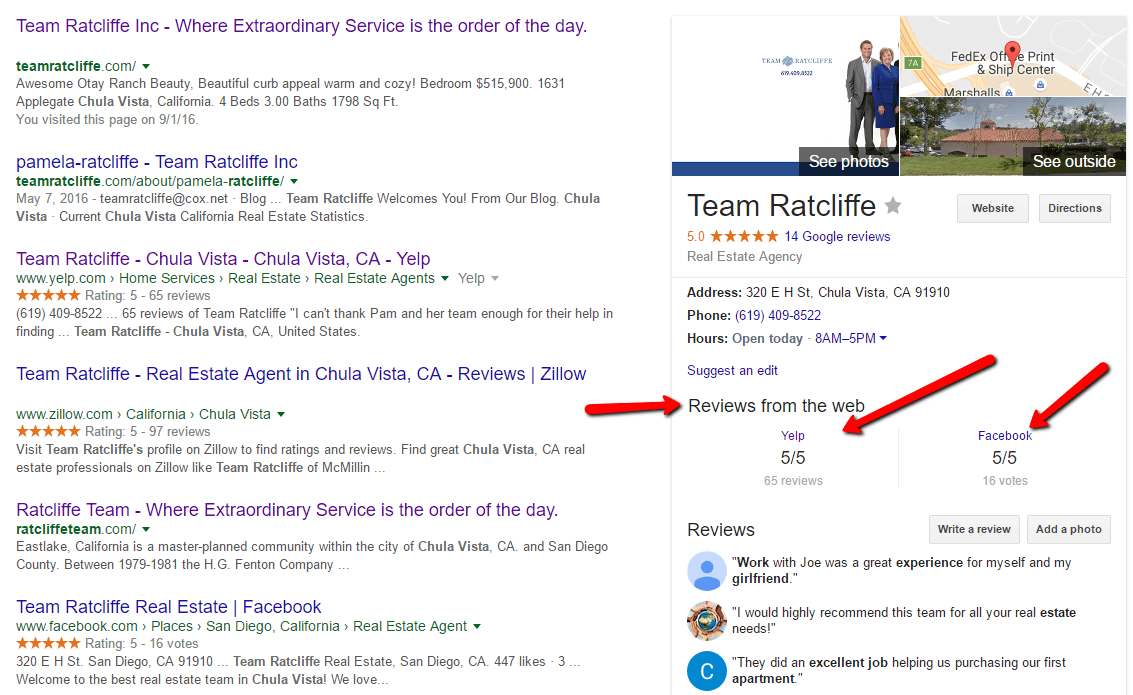
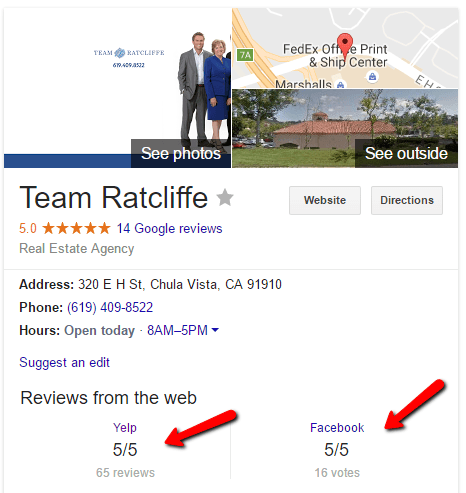
We ran across an exciting addition to the Google Business Page boxes that appear in the upper right of Google page one search results for for businesses that have created or claimed their Google business page. You have heard me say, “If the largest search engine in the world has a review system, you should probably pay attention to it”.  This is why we promote the use of Google reviews as a primary source of your online reviews. Based on the image below, you will see in addition to the Google reviews, you will see Facebook and Yelp reviews are showing up in the Google business box section called “Reviews from the web”.

From a perspective of the importance of having online reviews, the fact Google has added Yelp and Facebook reviews to their business box is quite telling. From what we can tell, the reviews are being automatically pulled and placed in the Google business box and is not a direct feed based upon some official data pipeline between Yelp, Facebook, Google and others. Here is a short video I did explaining it.

In a prior blog post where I wrote about stats that came directly from Google regarding the fact 49% of your prospects want to trust you along with this latest addition of Yelp and Facebook reviews shows me now it’s more important then ever to take control of your online reviews. Please reach out to us for a free demo on how we can manage all of this for you.


How to find out if you actually OWN your real estate website design

When you attend a real estate marketing event I am speaking at, you will hear me say, “Why rent when you can own?” I am speaking of websites of course and not home sales. In an older post I go over all the different types of real estate websites you can have designed, but at the end of the day, if you want to own your website outright, your options are few.

I recently had a Realtor post in the Lab Coat Agents Facebook group asking about websites. We had a private discussion about real estate website design and the next day she asked me, “How do I know if I will actually own the website once I order it?” This is a great question because there are sales reps telling prospects they will own their website when in all reality, they may own their content but not the container.

These are the questions to ask:

“OK, so you are telling me I own the website. That would mean if I wanted to, I could take the website and move it to my personal hosting account on Godaddy. Right?”

“And if I own the website, I can have one of my web developers go in and make modifications?”

“And if it is WordPress, not only can I host it anywhere, but I have full admin controls and can add any plugins, pages, script or code I want. Correct?

“And lastly, if I own the site I can switch out the IDX anytime I want?”

If they answer no to any of the above, you don’t own your website. I am not saying this is a horrible thing mind you if you are happy with the website you are renting and the marketing services that web developer is offering. I just feel you need to have complete control over the history of your online branding.

For example, Keller Williams agents and teams represent a majority of our business. Many KW agents use the web system provided by KW. For the longest time that was a website system provided by Market Leader. Some Keller Williams agents had horribly outdated Market Leader sites for years. Then at last year’s Family Reunion, it was announced that they were going with Placester which was a HUGE improvement. Still though, I feel agents with any major national real estate franchise should be off the corporate grid as much as possible and control their branding outright.

At the end of the day you want leads, and maybe owning your website is not a big deal to you. This is why you go with the big lead gen companies that generate leads via PPC campaigns, and loan you a website while you are using their marketing system. This is a great strategy if you have the budget, however I still feel you need to own the “mother ship”.

The mother ship should be WordPress based and the blog should be activated. You should own your site outright so you can build an online history through blogging and community specific landing pages. Your site should have an IDX integrated that will allow for the search engines to essentially index the MLS as if you owned it. When you Google the street address of one of your listings and see your competitors with your listing on their website, they have this indexing active. We are an IDX Broker Developer Partner.

Question for you, setting aside international real estate brokerages that change website platforms for their agents, have you ever been victim to a website provider going out of business? As a personal favor to a major player in the industry I won’t mention the company name, but they went out of business giving their clients 30 days notice. Many Realtors had procrastinated and were left without websites for a time. If you own your own site, this does not happen.

There is no major conspiracy from real estate website vendors to keep you from owning your own website. There are some great website providers in the marketplace that have developed some great call to action (CTA’s) processes for lead generation provided you are getting the traffic. Most of these technologies are proprietary in nature and can only be served up through an internal shared site server system within their control. No way around it, and that’s OK if you are happy with the results you are getting.

Lastly, If you are renting your website make sure it has a blog in a sub-directory and not a sub-domain. And so that you don’t lose your online blogging history should you ever change website providers, make sure they have a way to transfer your content to you should you ever leave.

Obviously by now you clearly understand my position on website ownership. Just make sure YOU clearly understand what you own vs what you are renting.
 

Google says 49% of real estate consumers look for trust

In other posts I have written about the importance having a well rounded positive online reputation. Having a great online reputation increases the ROI of your marketing dollars.

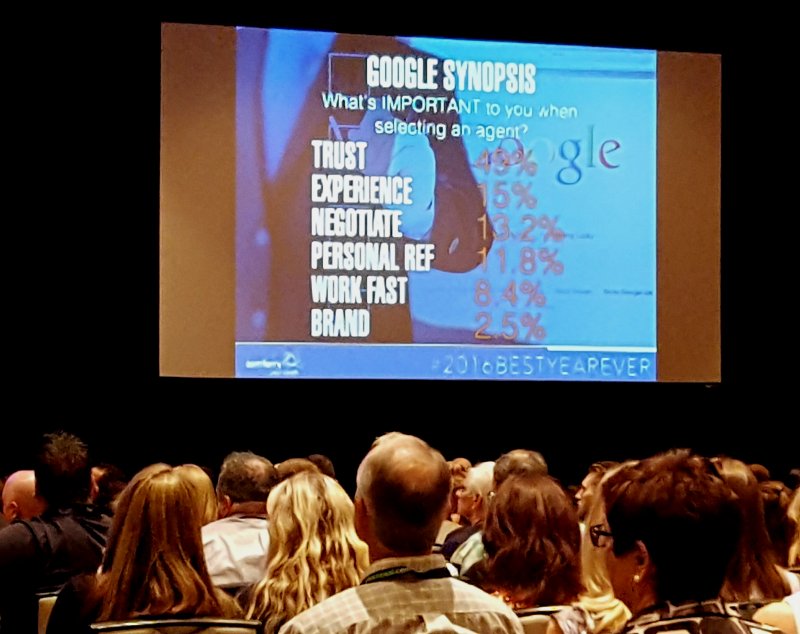
Yesterday while I was attending the Real Estate Mastermind Summit, Tom Ferry was the speaker and he told us he was asked to attend an event at Google wherein the movers and shakers of real estate marketing came together to discuss strategies. Tom put up the following slide:

Google, using stats and surveys, determined what was most important to the consumer when selecting a real estate agent. It’s hard to see in my photo, but TRUST was number one at 49%. In second place was EXPERIENCE at 15% and so on down the list. TRUST represented half within this study.

So how do you get trust? Obviously direct referrals from their friends communicates THEY trust you. Some trust may come into play after meeting you. In 2014, Placester and T3Experts conducted research regarding online reviews. They found 85% of consumers use online reviews to evaluate local businesses and professionals. They also found 90% trusted peer recommendations like online reviews 6.5 times more then traditional advertising. The percentages of consumers looking to online reviews for Realtors is growing each year.

Your online snapshot is everything. Agent Reputation gives you the tools you need to get reviews where they count. Google, Yelp and Facebook

CJ Hays @area51testpilot

Realtors need to quit trying to manipulate Yelp

Referencing a blog post I wrote on Active Rain earlier this year, I continually see Realtors trying to manipulate their Yelp reviews. Enough real estate agents know about me and my company, Agent Reputation, that I am continually getting questions about how to get Yelp reviews to stick. Or maybe they think there is some kind of conspiracy that requires buying advertising from Yelp in order to get non-recommended reviews published or bad reviews removed.

  1. No conspiracy. There were some overzealous Yelp sales reps back in the day that may have inferred a relationship between reviews and ads but that was firmly dealt with. Anybody that claims different is misinformed.
  2. Yelp does not want you asking for reviews. They want “active” Yelpers to be motivated by the service you provide to leave organic reviews. As a real estate agent, you can have a Yelp presence on your website or reputation marketing program and the Yelpers who feel motivated will know what to do.
  3. DO NOT send out an e mail blast asking everyone you know to leave you a Yelp review. Yelp has an algorithm that tracks the review. If you send out a blast, Yelp will see red flags because too many reviews came in at once which is an indicator you sent out a blast asking for reviews. Secondly they track new Yelp users. They know when somebody signs up just to leave a review and depending on their future Yelp activity, this review will wind up under the line as a non-recommended review. This can also protect you because it will also push some of your bad reviews under the line. So basically if you went to the effort to ask a bunch of non-Yelpers to leave you a review, you just wasted their time when they could have been leaving you a review on Google, Facebook or Zillow.
  4. What is a Yelper? A Yelper signs up to participate in the online review community. They are interested in the reviews of other Yelpers and are motivated to leave their own reviews. Yelpers have a profile photo. They have downloaded the Yelp App to their phone. They check in from businesses they are visiting via the app. They write reviews from these businesses they have checked in from. They have Yelp friends and at the end of the day if these active Yelpers leave you a review, it will be above the line and credible.

Yelp should be embraced. I have real estate agent clients that have over 50 positive reviews with very few under the line. And in fact once these clients get their reviews up they are buying Yelp ads and are killing it.

CJ Hays – Follow me on Twitter

#CJ4marketing

Do not use real estate blogging services providing duplicate content

So I was on the net today looking at the online reputations of major real estate agents just for research. I am talking major players. I came across one agent who is a trainer and an agent on the West Coast. He has two real estate websites. One is a blog that he has not touched in the past year and the other is a new site he just launched with 4 blog posts from earlier this month. Setting aside the fact he does not actually own his website, in reviewing the posts, it was a no brainer for me that he did not write these posts. After additional research it was obvious this was content being provided by his website provider.

If your website provider is posting content to your site you have to be careful because this content could also be posting to hundreds of other websites within their platform. It is really easy to research. Look at the post and copy a unique sentence from the post like “As the events of the last few years in the real estate industry show” which I found in a blog post I reviewed and you will see this blog post is sitting on many other sites. Follow this link to see the results.

MOZ states, “Duplicate content is content that appears on the Internet in more than one place (URL). When there are multiple pieces of identical content on the Internet, it is difficult for search engines to decide which version is more relevant to a given search query. To provide the best search experience, search engines will rarely show multiple duplicate pieces of content and thus, are forced to choose which version is most likely to be the original—or best.

Search engines don’t know which version(s) to include/exclude from their index
Search engines don’t know whether to direct the link metrics (trust, authority, anchor text, link juice, etc.) to one page, or keep it separated between multiple versions
Search engines don’t know which version(s) to rank for query results
When duplicate content is present, site owners suffer rankings and traffic losses, and search engines provide less relevant results.”

Google wants original content in your blogging. You can hyper-local blog about current events or breaking news. You can blog about new listings before they go into the MLS. Blog posts can be short and sweet. The search engines would like to see at least 2 blog posts per week. Consistency is the key. Real Time blogging is also important.

If you have no time to blog you can hire a professional blogger but be be careful as I have seen issues with hiring overseas bloggers. Imagine having an overseas blogger write about a new restaurant in Texas and featuring a photo from Hong Kong. That happened.

Blogging needs to be one of your best friends and being so busy that you have to use posts on a hundred other sites is no excuse if you want to do it right.

CJ Hays – Follow me on Twitter

#CJ4marketing

Twitter adjusting The 140 Character Limit On Tweets

When you add links or images to a Twitter post you don’t actually get the full 140 characters to leave you statement. Links and images eat up your allowable characters. In a quote published from Bloomberg, “Twitter will soon stop counting photos and links as part of its 140-character limit for messages, according to a person familiar with the matter. The change could happen in the next two weeks, said the person who asked not to be named because the decision isn’t yet public. Links currently take up 23 characters, even after Twitter automatically shortens them. The company declined to comment.”

CJ Hays – Follow me on Twitter

#CJ4marketing


The difference between “Breaking” and “Trending” news in blogging

Of the 4 computer monitors on my desk, one is monitoring breaking news via RSS feeds. I like to stay current on the news of the day and I am looking for opportunities to get Google’s attention via “breaking news” blogging or what has been referred to as “Real Time Blogging”.

Real time blogging is the act of sharing content as it happens.

I am a “what if” kind of guy as I am always thinking of ways my agents can compete online with original content that is going to get the attention of the search engines and their local consumers.

A number of years ago I said to myself, “What if I blogged about breaking news? Would Google notice my post?”

A press release came out from Mayor Bloomburg in New York stating, he was going to regulate the size of soft drink cups sold in NYC convenience stores. At the time, I was blogging for a nutritional company I was consulting for. Within 5 minutes of the story hitting the AP wire, I wrote a simple post that basically stated, “Don’t tell me what I can or cannot drink” and “If you drink that much soda per day you are harming your body”. For the next 5 months my post shared page one of Google with the Huffington Post, USA Today and the New York Times. I was the only non-news source in the search results. For the first 30 days this post was averaging around 7,000 hits per day.

I blogged about a celebrity being arrested in Las Vegas, only as an experiment. I not only wrote about it as the arrest was going down, but I beat TMZ to the punch on the mug shot. 20,000 hits per day for the first 2 weeks on average and the mugshot was in the top-ten image searches for over a year.

Within my research in various experimental blogs I was managing, I was writing about news as it was happening(Breaking) AND popular news(Trending). When I wrote about trending yet popular news, though my posts were indexed, they were really nowhere to be found. At the time my posts came out they were lost in a sea of other posts and news sites.

Blogging about breaking news ranks higher in the search engines then trending news.

So you ask, “CJ, how does writing about breaking, non-real estate related news help me sell real estate or generate leads?” I am glad you asked.

It’s is more of an indirect credibility tool for you and your blog. The search engines notice publication dates and clickthrough activity. If you get their attention enough times, they recognize your blog as a credible news source. Sometimes your blog is located on your website, hopefully in a sub directory(the the right of the .com) and not in a sub-domain(to the left of your domain name). This of course helps your overall SEO and when you write about hyper-local event or properties in your market, you will shoot straight to the top.

My research has also shown me our posts on Active Rain are getting indexed quickly with great positioning. This is because Active Rain is probably recognized by the Google algorithms as a very active and credible repository of original content. If you hyper-local blog about breaking news in your area, there is a very good chance your Activerain.com post will get hit by consumers in your area who can see your contact information.

Writing about breaking news on Active Rain will index quickly with great placement

CJ Hays – Follow me on Twitter

#CJ4marketing


CJ Hays Featured on Super Agents Live Podcast with Toby Salgado

I was asked to be a guest on Super Agents Live hosted by Toby Salgado a few weeks ago. I discussed online marketing strategies for real estate agents including online reviews, reputation marketing and the correct use of Youtube. This marketing podcast is an hour in length and can be accessed here. I start around 4 minutes into the broadcast.

CJ Hays – Follow me on Twitter

#CJ4marketing

Using the Hermann Grid illusion in real estate website design

I was recently researching a news article on three Manhattan properties that are the most expensive properties on the market. $95 Million+.

This led me to a real estate agent search page located on a high end brokerage site wherein they used black boxes containing the individual agent information and links. These black boxes are separated with white space. When you visit the page you will start to see grey blobs within the intersections of the white space. And in fact, depending on your vision, these blobs will make it quite uncomfortable to look around the page for the agent of inquiry.

I have seen this before in an optical illusion called the Hermann Grid Illusion.

Hermann Grid IllusionThe Hermann grid illusion is an optical illusion reported by Ludimar Hermann in 1870. The illusion is characterized by “ghostlike” grey blobs perceived at the intersections of a white (or light-colored) grid on a black background. The grey blobs disappear when looking directly at an intersection.

I am sure the designer had no clue they were creating a layout that would be so annoying to the visual cortex but this illusion will make most people want to leave the page as quickly as possible. If I were to redesign the agent directory, I would make the agent boxes white with a thin dark border on each box and possibly a light grey background. In fact I am sure the image I have placed on the page is distracting you as you are trying to read this post

It is hard enough getting traffic to a site much less keep people on the site. We have to design sites that make the eyes comfortable, easy to navigate, and provide action points as quickly as possible.

CJ Hays – Follow me on Twitter

#CJ4marketing