
Historical Content Retention(HCR) With Real Estate Websites You Own

Many of you know my stand on website ownership vs renting your real estate website. It all boils down to owning your online assets and the SEO value of your Historical Content Retention(HCR).

Blogging needs to be a real estate agents best friend. In a perfect world, you are blogging on a WordPress website you OWN at least twice a week, if not every day. As long as you stay with WordPress, you can always upgrade to new sites and the content you created will will stay intact with any images, videos, dates and the URL it was indexed on.

As a real estate agent actively blogging, if you are renting your website that has a blog and you choose to buy a new real estate website, you may end up throwing away the historical SEO value of your prior active blogging. And in fact, every time you change websites, the search engines have to re-index your new site and this can lead to essentially starting over with a blank slate in the search engines.

I was with one of the first companies that brought WordPress to real estate. Ease of content creation, maintenance, SEO attractiveness and blogging was and still are strong points with having a WordPress real estate website. Then about 4 years ago, new companies started offering cheap monthly rental websites with blogging technology. So many of you created pages and pages of content over a period of years and at the moment you choose to go with another site, you are told there is no easy way to import your prior content into your new site.

But you thought your website was built in WordPress and you just purchased a WordPress website. The site may have been built with the same base php technology, but if your dashboard does not look like this, you are out of luck.
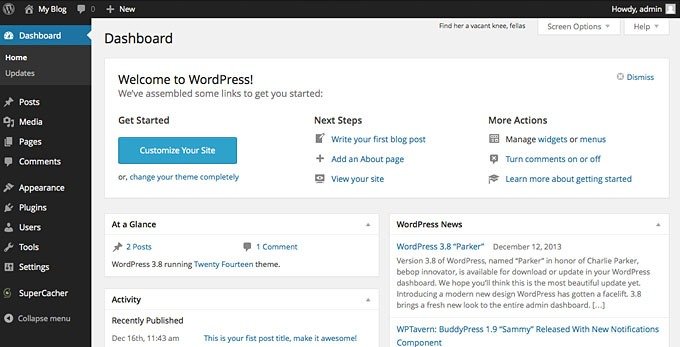
So if you buy a WordPress real estate website and you want to bring over your months or years of content from a site that does not have this backend, you will have to manually reenter your posts. Your valuable history will be gone. All of this content including the images will have to be re-indexed. Not a good scenario.

All I am asking you to do is think about where your content is being posted. Do you have full control of that asset? Is your content exportable if you change site providers? Will your historical content retention be up to date?

Don’t get me wrong. I am not trying to talk you out of your amazing PPC or Paid Leadgen website. All of these leads you are paying for have to go through that vendor’s online process, some of which are off the hook. I am just advising you to think about placing your unique personal content within a technology you own and control.


Do not use real estate blogging services providing duplicate content

So I was on the net today looking at the online reputations of major real estate agents just for research. I am talking major players. I came across one agent who is a trainer and an agent on the West Coast. He has two real estate websites. One is a blog that he has not touched in the past year and the other is a new site he just launched with 4 blog posts from earlier this month. Setting aside the fact he does not actually own his website, in reviewing the posts, it was a no brainer for me that he did not write these posts. After additional research it was obvious this was content being provided by his website provider.

If your website provider is posting content to your site you have to be careful because this content could also be posting to hundreds of other websites within their platform. It is really easy to research. Look at the post and copy a unique sentence from the post like “As the events of the last few years in the real estate industry show” which I found in a blog post I reviewed and you will see this blog post is sitting on many other sites. Follow this link to see the results.

MOZ states, “Duplicate content is content that appears on the Internet in more than one place (URL). When there are multiple pieces of identical content on the Internet, it is difficult for search engines to decide which version is more relevant to a given search query. To provide the best search experience, search engines will rarely show multiple duplicate pieces of content and thus, are forced to choose which version is most likely to be the original—or best.

Search engines don’t know which version(s) to include/exclude from their index
Search engines don’t know whether to direct the link metrics (trust, authority, anchor text, link juice, etc.) to one page, or keep it separated between multiple versions
Search engines don’t know which version(s) to rank for query results
When duplicate content is present, site owners suffer rankings and traffic losses, and search engines provide less relevant results.”

Google wants original content in your blogging. You can hyper-local blog about current events or breaking news. You can blog about new listings before they go into the MLS. Blog posts can be short and sweet. The search engines would like to see at least 2 blog posts per week. Consistency is the key. Real Time blogging is also important.

If you have no time to blog you can hire a professional blogger but be be careful as I have seen issues with hiring overseas bloggers. Imagine having an overseas blogger write about a new restaurant in Texas and featuring a photo from Hong Kong. That happened.

Blogging needs to be one of your best friends and being so busy that you have to use posts on a hundred other sites is no excuse if you want to do it right.

CJ Hays – Follow me on Twitter

#CJ4marketing

The difference between “Breaking” and “Trending” news in blogging

Of the 4 computer monitors on my desk, one is monitoring breaking news via RSS feeds. I like to stay current on the news of the day and I am looking for opportunities to get Google’s attention via “breaking news” blogging or what has been referred to as “Real Time Blogging”.

Real time blogging is the act of sharing content as it happens.

I am a “what if” kind of guy as I am always thinking of ways my agents can compete online with original content that is going to get the attention of the search engines and their local consumers.

A number of years ago I said to myself, “What if I blogged about breaking news? Would Google notice my post?”

A press release came out from Mayor Bloomburg in New York stating, he was going to regulate the size of soft drink cups sold in NYC convenience stores. At the time, I was blogging for a nutritional company I was consulting for. Within 5 minutes of the story hitting the AP wire, I wrote a simple post that basically stated, “Don’t tell me what I can or cannot drink” and “If you drink that much soda per day you are harming your body”. For the next 5 months my post shared page one of Google with the Huffington Post, USA Today and the New York Times. I was the only non-news source in the search results. For the first 30 days this post was averaging around 7,000 hits per day.

I blogged about a celebrity being arrested in Las Vegas, only as an experiment. I not only wrote about it as the arrest was going down, but I beat TMZ to the punch on the mug shot. 20,000 hits per day for the first 2 weeks on average and the mugshot was in the top-ten image searches for over a year.

Within my research in various experimental blogs I was managing, I was writing about news as it was happening(Breaking) AND popular news(Trending). When I wrote about trending yet popular news, though my posts were indexed, they were really nowhere to be found. At the time my posts came out they were lost in a sea of other posts and news sites.

Blogging about breaking news ranks higher in the search engines then trending news.

So you ask, “CJ, how does writing about breaking, non-real estate related news help me sell real estate or generate leads?” I am glad you asked.

It’s is more of an indirect credibility tool for you and your blog. The search engines notice publication dates and clickthrough activity. If you get their attention enough times, they recognize your blog as a credible news source. Sometimes your blog is located on your website, hopefully in a sub directory(the the right of the .com) and not in a sub-domain(to the left of your domain name). This of course helps your overall SEO and when you write about hyper-local event or properties in your market, you will shoot straight to the top.

My research has also shown me our posts on Active Rain are getting indexed quickly with great positioning. This is because Active Rain is probably recognized by the Google algorithms as a very active and credible repository of original content. If you hyper-local blog about breaking news in your area, there is a very good chance your Activerain.com post will get hit by consumers in your area who can see your contact information.

Writing about breaking news on Active Rain will index quickly with great placement

CJ Hays – Follow me on Twitter

#CJ4marketing