Be very careful how you approach your clients for Yelp reviews

So I am on Facebook a few days ago and a local businessman puts out a boosted/sponsored post asking everyone to leave him Yelp reviews. Not only did he pay for a FaceBook ad to solicit these reviews, but he offered a reward of free services if they did so. Yelp’s recommendation software is designed to highlight reviews from people inspired to share their experiences with the community. Yelp wants its ACTIVE Yelpers to organically feel motivated to leave a review.

I had commented on his post that he can’t offer rewards for reviews and that only ACTIVE Yelpers who actually did business at his establishment would show up as a published review. He responded that as long as the member of Yelp had at least two reviews it would count. Not true at all.

Active Yelpers have the Yelp app on their phone. They check in from businesses. They have a profile picture. They write reviews. They have friends. They participate in the Yelp community.

Yelp has a gate keeper of sorts. If somebody signs up for Yelp, leaves a review a few minutes later and is never heard from again, that review will go what I call, “Under the line”. It will be a non-recommended review. In this case, the business has over 50 reviews under the line. When you look at these non-recommended Yelp reviews you will see two things. Most of the reviewers have only written one review and some reviews all came in on the same day which usually points to the business asking others through a blast to leave a review.

If you embrace Yelp, not try to GAME Yelp and provide the best service you can, you will have a great online presence. With that said, don’t forget your Google Business Page. It is safe to say if the largest search engine in the world as a review system, you should probably pay attention to it.


Realtor reviews from Yelp and Facebook now showing up in Google Business pages

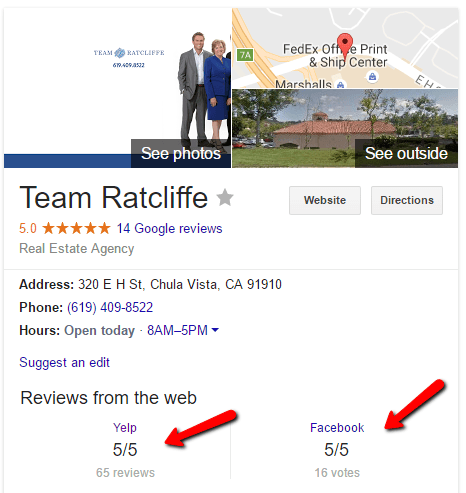
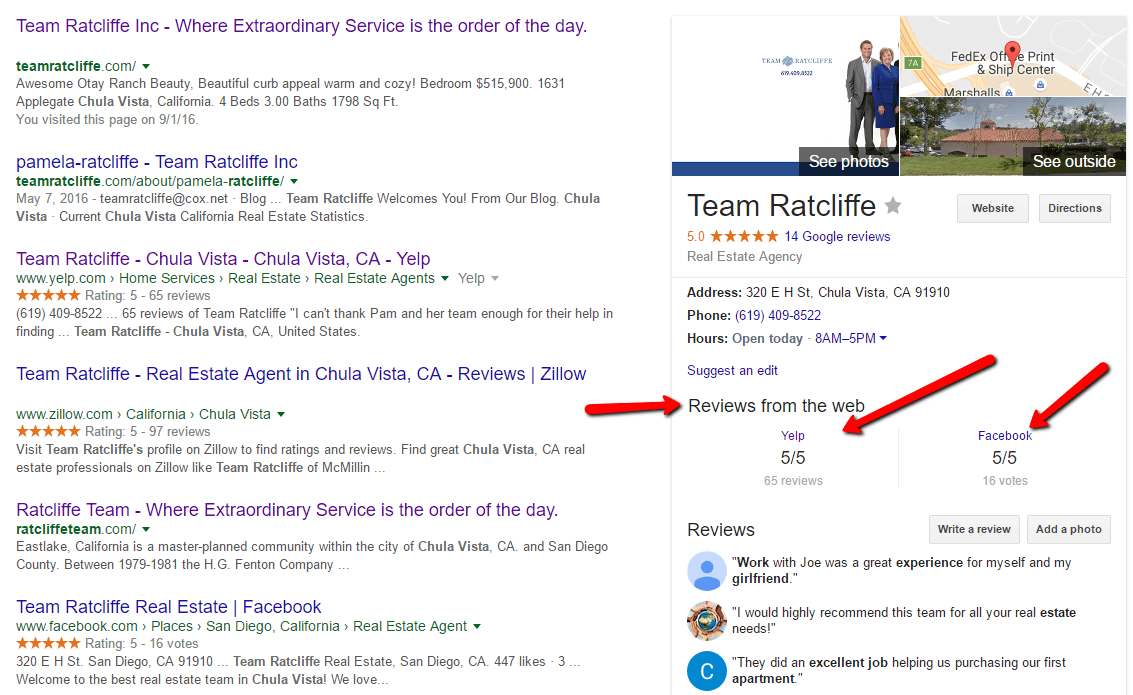
We ran across an exciting addition to the Google Business Page boxes that appear in the upper right of Google page one search results for for businesses that have created or claimed their Google business page. You have heard me say, “If the largest search engine in the world has a review system, you should probably pay attention to it”.  This is why we promote the use of Google reviews as a primary source of your online reviews. Based on the image below, you will see in addition to the Google reviews, you will see Facebook and Yelp reviews are showing up in the Google business box section called “Reviews from the web”.

From a perspective of the importance of having online reviews, the fact Google has added Yelp and Facebook reviews to their business box is quite telling. From what we can tell, the reviews are being automatically pulled and placed in the Google business box and is not a direct feed based upon some official data pipeline between Yelp, Facebook, Google and others. Here is a short video I did explaining it.

In a prior blog post where I wrote about stats that came directly from Google regarding the fact 49% of your prospects want to trust you along with this latest addition of Yelp and Facebook reviews shows me now it’s more important then ever to take control of your online reviews. Please reach out to us for a free demo on how we can manage all of this for you.


Google says 49% of real estate consumers look for trust

In other posts I have written about the importance having a well rounded positive online reputation. Having a great online reputation increases the ROI of your marketing dollars.

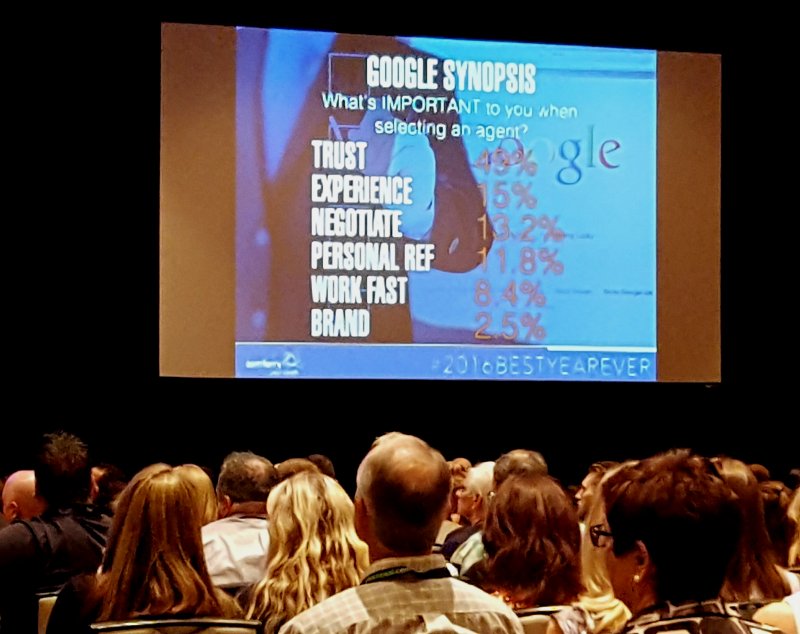
Yesterday while I was attending the Real Estate Mastermind Summit, Tom Ferry was the speaker and he told us he was asked to attend an event at Google wherein the movers and shakers of real estate marketing came together to discuss strategies. Tom put up the following slide:

Google, using stats and surveys, determined what was most important to the consumer when selecting a real estate agent. It’s hard to see in my photo, but TRUST was number one at 49%. In second place was EXPERIENCE at 15% and so on down the list. TRUST represented half within this study.

So how do you get trust? Obviously direct referrals from their friends communicates THEY trust you. Some trust may come into play after meeting you. In 2014, Placester and T3Experts conducted research regarding online reviews. They found 85% of consumers use online reviews to evaluate local businesses and professionals. They also found 90% trusted peer recommendations like online reviews 6.5 times more then traditional advertising. The percentages of consumers looking to online reviews for Realtors is growing each year.

Your online snapshot is everything. Agent Reputation gives you the tools you need to get reviews where they count. Google, Yelp and Facebook

CJ Hays @area51testpilot

Realtors need to quit trying to manipulate Yelp

Referencing a blog post I wrote on Active Rain earlier this year, I continually see Realtors trying to manipulate their Yelp reviews. Enough real estate agents know about me and my company, Agent Reputation, that I am continually getting questions about how to get Yelp reviews to stick. Or maybe they think there is some kind of conspiracy that requires buying advertising from Yelp in order to get non-recommended reviews published or bad reviews removed.

  1. No conspiracy. There were some overzealous Yelp sales reps back in the day that may have inferred a relationship between reviews and ads but that was firmly dealt with. Anybody that claims different is misinformed.
  2. Yelp does not want you asking for reviews. They want “active” Yelpers to be motivated by the service you provide to leave organic reviews. As a real estate agent, you can have a Yelp presence on your website or reputation marketing program and the Yelpers who feel motivated will know what to do.
  3. DO NOT send out an e mail blast asking everyone you know to leave you a Yelp review. Yelp has an algorithm that tracks the review. If you send out a blast, Yelp will see red flags because too many reviews came in at once which is an indicator you sent out a blast asking for reviews. Secondly they track new Yelp users. They know when somebody signs up just to leave a review and depending on their future Yelp activity, this review will wind up under the line as a non-recommended review. This can also protect you because it will also push some of your bad reviews under the line. So basically if you went to the effort to ask a bunch of non-Yelpers to leave you a review, you just wasted their time when they could have been leaving you a review on Google, Facebook or Zillow.
  4. What is a Yelper? A Yelper signs up to participate in the online review community. They are interested in the reviews of other Yelpers and are motivated to leave their own reviews. Yelpers have a profile photo. They have downloaded the Yelp App to their phone. They check in from businesses they are visiting via the app. They write reviews from these businesses they have checked in from. They have Yelp friends and at the end of the day if these active Yelpers leave you a review, it will be above the line and credible.

Yelp should be embraced. I have real estate agent clients that have over 50 positive reviews with very few under the line. And in fact once these clients get their reviews up they are buying Yelp ads and are killing it.

CJ Hays – Follow me on Twitter

#CJ4marketing

Why some Realtors think Yelp is harming them – Stats and Algorithms

First off I want to give a shoutout to Matthew Bushery at Placester.com who recently wrote a great article on Yelp.

Today’s post is inspired by a Realtor I spoke to this afternoon as I was going over their reputation report. Other then their awesome Zillow reviews, the Google footprint was a bit weak. And their Yelp page showed 7 reviews with a 2-Star average rating. There were “18 other reviews that are not currently recommended” below the line.

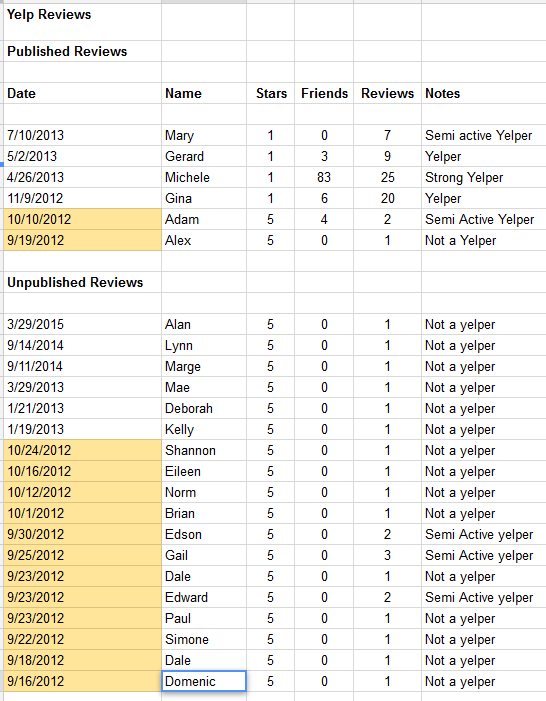
This always upsets companies or business professionals reviewed on Yelp. Using this image below, I will lay out a response that will hopefully help you to understand a bit more about how Yelp works.

When I Googled this Realtor, the 2-star Yelp review was staring me in the face. I know they felt harmed by Yelp for hiding 18 5-star reviews and publishing four 1 star horrible reviews. Setting aside the fact they will never be able to terminate their Yelp account, I wanted to offer some insight.

Two of the negative reviews stated the reviewer actually had completed real estate transactions with this agent. I had suggested that if these two reviewers were making this up, the agent could ask their broker to write a letter stating they never had clients with these names which could be submitted to Yelp for review.

On or about 9/16/2012, this agent or somebody representing them sent out an e mail to a mix of prior clients, friends or family letting them know they established a Yelp account and they were asked to leave you a 5 star review.

Starting on the 16th and continuing through 10/24/2012 a total of fourteen 5-star reviews came in to Yelp. That is unnatural and is a big red flag. Then when you see that most of these reviews have had zero activity in the past three years, based upon their algorithm and tracking, Yelp assumes they asked all of these people to leave them positive reviews which is against their guidelines.

The “zero friend/one review” accounts under the line, most likely signed up to leave them a review and then immediately left that review, never to be heard from again on Yelp. Yelp tracks that. You simply cannot ask non-Yelpers to leave you reviews or they will be buried.

Now IF any of the inactive Yelpers became active, there is a chance this activity might get the reviews after 10/24/2013 published

I was going to suggest getting an additional letter from the brokerage or providing transaction documentation tied to each name of those below the line for submittal to Yelp, but if it was within the dates I mentioned, it probably wouldn’t matter because so many reviews came in within such a short time-frame. You might be able to do this with the three reviews from 2014/15 and get those upgraded.

They have all of these reviews from 2012, most of which don’t count. Six from 2013. Two from 2014 and only one this year. This shows they had a push in 2012 and then sat back to allow natural review postings which is why these four one star reviews are published along with the reviewers Yelp activity.

A correct strategy at the moment the client is doing the happy dance, for all transactions moving forward, is to mention you are building your online reputation and to find out if they are active online reviewers. It really would not take many to push you up. But they have to be Active Yelpers.

They want active Yelpers to be motivated to find the vendors they do business with and leave honest reviews on their own. You also can’t just sit back “hoping” you get reviews. You have to be proactive. You need a plan. We have that plan.

CJ Hays @area51testpilot #CJ4marketing

Thoughts on Inman News Article re Online Agent Ratings

On August 6th, Inman News published an article called, “Online agent ratings may be inflated, but they’re still valuable”, written by Teke Wiggin, Technology Writer for Inman. The article seems to be focused on Zillow reviews. I will go point by point.

“Realtors have become restaurants” is the name of my seminar, so when I saw the opening paragraph of the article stating that consumers were using third party review systems for restaurants, hotels, and product purchases, I was pleased to anticipate the body of the article.

YES, consumers are using third party review systems like Yelp, Trip Advisor and the like to look at the credibility of vendors or products. However, while a foodie may use the Yelp app via their phone to look for a quality restaurant, the majority of consumers are first using the search engines to look for (Google) the name of the business, business professional or product. Consumers are Googling Realtors.

What do they see on page one of the search? Do they see gold stars? Do they see only Zillow? Do they see a Realtor’s Yelp account? Does the Realtor have a Google business page? Do they have Google ratings? Seriously, when a consumer Googles a real estate agent, they had better see multiple review systems in place. Having reviews across multiple platforms increases the credibility of the business professional.

A statement is made in the article that online agent ratings may be inflated. What does this mean? The article seems to tie this statement to the fact that Realtors are only asking the really happy consumers to leave reviews, thus skewing the online rating of the agent. Yes, if you as an agent are guiding ONLY your happy consumers to leave you positive reviews on Zillow or elsewhere, then a consumer may not be seeing an accurate representation of your integrity and professionalism. With that said, most consumers won’t realize this.

Another statement reads, “The reason why negative reviews are few and far between may be because many people who aren’t thrilled with an agent’s performance don’t feel the need to broadcast their disappointment”. I totally disagree. You have heard variations of actions consumers will take depending on their satisfaction with a product or service. They might tell a few people if they’re happy, but they will tell the whole world online if they are really upset!

The question is whether or not the agent is tech savvy enough to have third-party review technologies in place, other than Zillow or an internal survey based system. Yelp can be a little intimidating for agents that don’t know how to use it correctly. You can embrace Yelp to your advantage. I have clients getting 10 solid leads a week from Yelp, but that is for another day.

Google Business is also a huge factor. It is safe to assume that if the largest search engine in the world has a review system, you should probably pay attention to it.

When I had first read the headline that “agent ratings may be inflated”, I thought the article had to do with the fact Zillow reviews can be gamed. And in fact, there are methods to game almost every review system with the exception of Yelp. As a former Fraud Examiner and having worked many online fraud cases, a number of odd agent reviews were brought to my attention which I investigated. I saw review numbers that did not add up.

I know, for instance, when we load a client’s customer list into our CRM, which sends out an email asking them to click on a link to leave an online review, we will get a 25% return. That 25% does not come easy. There is an entire trickle system in place to get the customers to leave their online reviews. I then compare the percentages I am aware of to numbers that seem excessive. When I see rating numbers that are equal to or even exceeding the known transactions of an agent, the red lights go off. I know how it is done.

If you are a Zillow client and you focus on Zillow for your lead generation, then by all means focus on your Zillow reviews, as you will stand out within their marketing system. Same goes for Trulia and Realtor.com. But please open or claim your Google and Yelp pages. I may not click on your website or Zillow, Trulia or Realtor.com page to see your reviews.

Agent Reputation – Online Reviews

Recently our Director of Marketing Chris “CJ” Hays, was invited to do a live interview with talk show host Danny Vegas, on WCBM. CJ talks about reputation marketing, and the importance of online reviews when it comes to generating more real estate leads. If people are going to list their home with you they need to trust you. Online reviews are like recommendations, and they need to be on the right websites, and highly visible.

Watch The Whole Interview Here