Be very careful how you approach your clients for Yelp reviews

So I am on Facebook a few days ago and a local businessman puts out a boosted/sponsored post asking everyone to leave him Yelp reviews. Not only did he pay for a FaceBook ad to solicit these reviews, but he offered a reward of free services if they did so. Yelp’s recommendation software is designed to highlight reviews from people inspired to share their experiences with the community. Yelp wants its ACTIVE Yelpers to organically feel motivated to leave a review.

I had commented on his post that he can’t offer rewards for reviews and that only ACTIVE Yelpers who actually did business at his establishment would show up as a published review. He responded that as long as the member of Yelp had at least two reviews it would count. Not true at all.

Active Yelpers have the Yelp app on their phone. They check in from businesses. They have a profile picture. They write reviews. They have friends. They participate in the Yelp community.

Yelp has a gate keeper of sorts. If somebody signs up for Yelp, leaves a review a few minutes later and is never heard from again, that review will go what I call, “Under the line”. It will be a non-recommended review. In this case, the business has over 50 reviews under the line. When you look at these non-recommended Yelp reviews you will see two things. Most of the reviewers have only written one review and some reviews all came in on the same day which usually points to the business asking others through a blast to leave a review.

If you embrace Yelp, not try to GAME Yelp and provide the best service you can, you will have a great online presence. With that said, don’t forget your Google Business Page. It is safe to say if the largest search engine in the world as a review system, you should probably pay attention to it.
 

Yelp DOES protect businesses from non-consumer experience review attacks

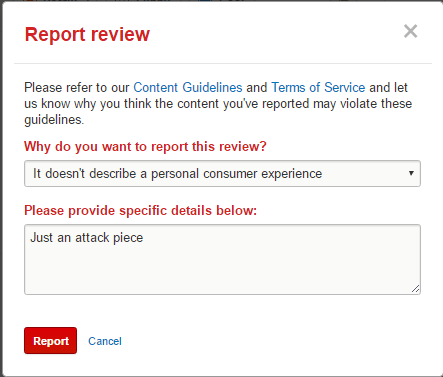
Do you remember last year when that dentist from Minnesota killed the lion in Africa? I was curious as to if the public would go to the Yelp page for his business and trash him. They did just that. I followed his reviews for a week and the one-star reviews just piled up. Other then manually flagging these reviews because the review “… doesn’t describe a personal consumer experience”, I was curious if Yelp was going to step in and filter the “attack” reviews. For the past year if a business owner made the news for being horrible, the same thing usually happened.

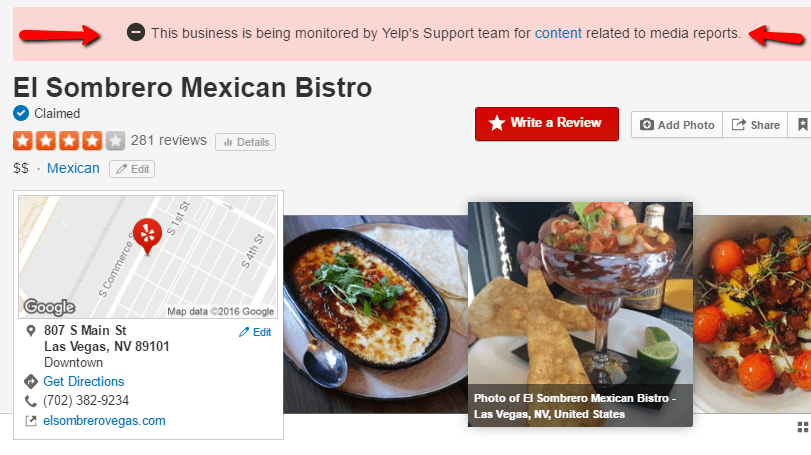
Locally, the El Sombrero Mexican Bistro in Las Vegas was under fire because Donald Trump paid them a visit. I only ran across this due to a story in the Las Vegas Review Journal yesterday written by Colton Lochhead, featuring the headline, “Las Vegas restaurant still cookin’ despite Hispanic community stir from Trump visit“.

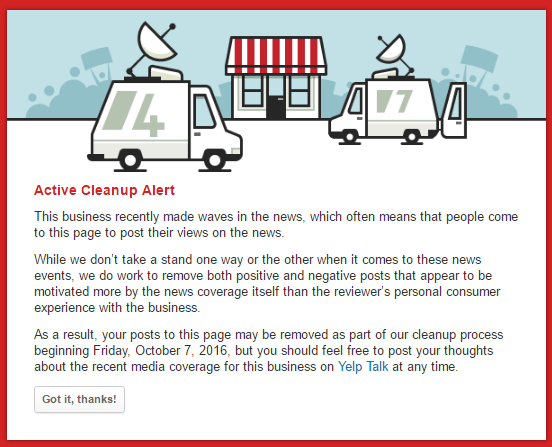
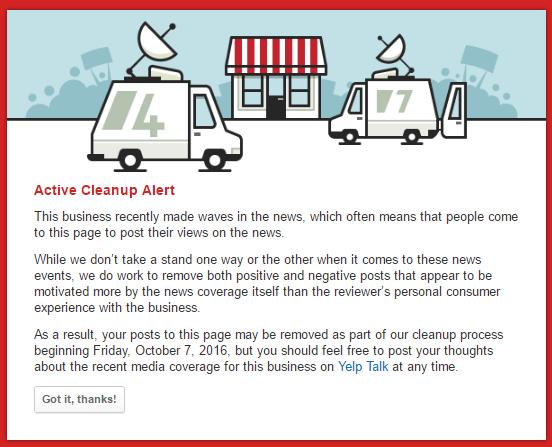
So once again, in conducting research for our reputation marketing business, I went to the Yelp Page for the El Sombrero Mexican Bistro to see if the political attack reviews were hot and heavy. I was surprised to the the following pop up window:

I had never seen a notification like this from Yelp ever. I was pleasantly surprised to see Yelp proactively protecting the online integrity of a small business from non-consumer reviews. Once you click “Got it, thanks!” and you are taken to the page this statement is in the header:

Living in Las Vegas and as a “Foodie”, I love going out to family owned, small, off the strip restaurants. I am also an active Yelper. Locally and when I travel, I rely on Yelp for trying new places. When the general public starts attacking a business due to politics it skews the online review process of whether the El Sombrero Mexican Bistro is a great place to eat.

FOOD not Politics

With that said, if you are a Yelper and ever see a post that does not represent an actual consumer experience, you can flag the review like I did here:

If you are a small business owner, whether a presidential candidate visits you or not, you should always be aware of your online reputation.

The Google 7-Pack is now a 3-Pack

About a year and a half ago, the 7-pack for residential Realtors in the US was removed from Google. It still existed for commercial Realtors and for some reason, residential Realtors in Canada. The 7-pack was a tool provided by Google when searching for businesses. You search for a business type and a map would show up in the upper right side of the screen, tied to 7 businesses marked from A through G. You would have to have a Google Business page, formerly known as Google Places, combined with some SEO, a website and hopefully some Google reviews. I personally think the 7-pack was removed to harm SEO for residential Realtors in the US. Six weeks ago the 7-Pack for residential Realtors came back. This was awesome as many of our clients who, via our process were located at the top of the seven-pack.

Yesterday I was demoing our reputation marketing services to a luxury agent in California when I noticed there were only three businesses located on page one of Google where there should have been seven. I had incorrectly assumed because the community was so small, I was only seeing three.

Today this article comes up online called, “Google Local Shakeup: 3-Pack Only, 7-Pack Removed; Addresses & Phone Numbers Gone“, by Jennifer Slegg. Wow, as I was basking in the fact the 7-pack came back, it is now the 3 business “Snack Pack”. You can read the article for the details.

An organic marketing target seven spaces wide would be better but three, but this is enough for us. These business listings are organic in nature and we have a plan that works. Call Us.