Do you have full control of your WordPress real estate website?

I was reading posts today on the Lab Coat Agents Facebook group and came across a discussion about real estate website designers. One company had mentioned their sites were WordPress. So if I buy their website, and if I was already familiar with WordPress then I would assume the dashboard would be a typical WP dashboard and I would have full Admin access. You would think so, right?

With that said, on many occasions when we have replaced websites built on the WP platform, we will transfer their entire blogging history with images, publish dates and the previously indexed content including the indexed URLs. We will also make sure their plugins remain intact. This way, when we launch their new website, though within a new theme, their history will be in the same URL location with the same publish date, thus not starting all over for their SEO. We ran into some specific occurrences where the client stated they had a WP site but when we signed into their dashboard, it looked nothing like a WordPress dashboard.

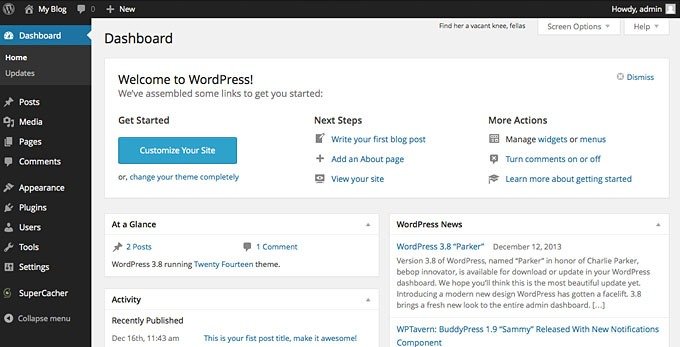
While your website may have been built using .php WordPress technology, your web developer may have created an entirely different dashboard interface. A typical WordPress dashboard looks like this:
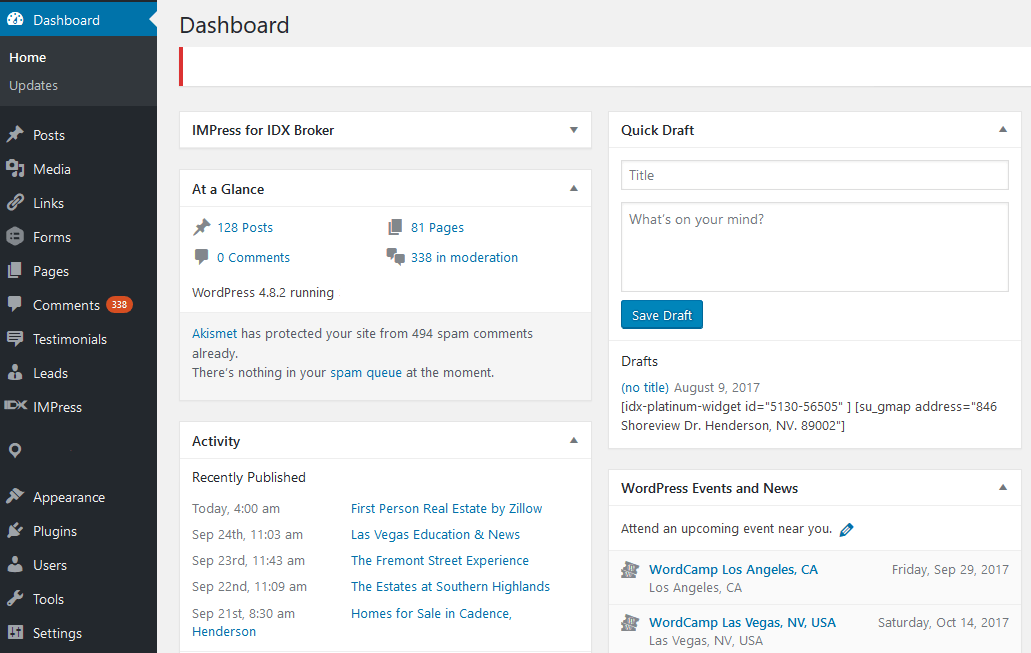
If your dashboard does not look anything like this, your web developer built a custom interface and this could cause future issues. One huge issue would be content migrations to a new WordPress real estate website if you choose to leave them. We had one client that had over 600 prior blog posts since 2012 and once we got in to the backend, we were at a loss. We had no way to zip up the folder and transfer to the new site. The client had to pay for many hours of work to have her posts manually recreated. Our backup plan would have been to FTP into her site and transfer the files, but the prior web developer would not give us FTP access. Probably because her website was being hosted in a multi-site shared server system which would also mean you don’t own the actual container(website).

Another issue would be the inability to place cool WordPress plugins on your website or maybe embedded technology or script. We run into this regularly when we place our Reputation Marketing technology on our client’s websites. They THINK they have full WP permissions, but again, when we sign in, we don’t see the dashboard. At that point we end up working with their soon to be prior web development company to get them to manually place our code into our clients real estate website.

WordPress web developers regularly create custom site management portals for a good number of reasons. Maybe they have combined the portal to not only manage the site but also give their clients CRM access. Or maybe they have a WIX style drag and drop design feature. Some devs will not give their clients full WP access so that the client does not destroy their own website, which I have seen happen. That reminds me. You may see a typical WordPress dashboard on your website when you sign in, but you may not have full admin permissions. You will know this if you only see a handful of feature tabs on the left hand side and no access to the USER tab.

I am not saying custom interfaces are bad. They can serve a purpose. Most WP developers can build custom dashboards for their client’s specific needs  But if you are thinking of buying or renting a WordPress real estate website, don’t just assume you will have typical WordPress access much less full admin access to your website.



Historical Content Retention(HCR) With Real Estate Websites You Own

Many of you know my stand on website ownership vs renting your real estate website. It all boils down to owning your online assets and the SEO value of your Historical Content Retention(HCR).

Blogging needs to be a real estate agents best friend. In a perfect world, you are blogging on a WordPress website you OWN at least twice a week, if not every day. As long as you stay with WordPress, you can always upgrade to new sites and the content you created will will stay intact with any images, videos, dates and the URL it was indexed on.

As a real estate agent actively blogging, if you are renting your website that has a blog and you choose to buy a new real estate website, you may end up throwing away the historical SEO value of your prior active blogging. And in fact, every time you change websites, the search engines have to re-index your new site and this can lead to essentially starting over with a blank slate in the search engines.

I was with one of the first companies that brought WordPress to real estate. Ease of content creation, maintenance, SEO attractiveness and blogging was and still are strong points with having a WordPress real estate website. Then about 4 years ago, new companies started offering cheap monthly rental websites with blogging technology. So many of you created pages and pages of content over a period of years and at the moment you choose to go with another site, you are told there is no easy way to import your prior content into your new site.

But you thought your website was built in WordPress and you just purchased a WordPress website. The site may have been built with the same base php technology, but if your dashboard does not look like this, you are out of luck.

So if you buy a WordPress real estate website and you want to bring over your months or years of content from a site that does not have this backend, you will have to manually reenter your posts. Your valuable history will be gone. All of this content including the images will have to be re-indexed. Not a good scenario.

All I am asking you to do is think about where your content is being posted. Do you have full control of that asset? Is your content exportable if you change site providers? Will your historical content retention be up to date?

Don’t get me wrong. I am not trying to talk you out of your amazing PPC or Paid Leadgen website. All of these leads you are paying for have to go through that vendor’s online process, some of which are off the hook. I am just advising you to think about placing your unique personal content within a technology you own and control.

How to find out if you actually OWN your real estate website design

When you attend a real estate marketing event I am speaking at, you will hear me say, “Why rent when you can own?” I am speaking of websites of course and not home sales. In an older post I go over all the different types of real estate websites you can have designed, but at the end of the day, if you want to own your website outright, your options are few.

I recently had a Realtor post in the Lab Coat Agents Facebook group asking about websites. We had a private discussion about real estate website design and the next day she asked me, “How do I know if I will actually own the website once I order it?” This is a great question because there are sales reps telling prospects they will own their website when in all reality, they may own their content but not the container.

These are the questions to ask:

“OK, so you are telling me I own the website. That would mean if I wanted to, I could take the website and move it to my personal hosting account on Godaddy. Right?”

“And if I own the website, I can have one of my web developers go in and make modifications?”

“And if it is WordPress, not only can I host it anywhere, but I have full admin controls and can add any plugins, pages, script or code I want. Correct?

“And lastly, if I own the site I can switch out the IDX anytime I want?”

If they answer no to any of the above, you don’t own your website. I am not saying this is a horrible thing mind you if you are happy with the website you are renting and the marketing services that web developer is offering. I just feel you need to have complete control over the history of your online branding.

For example, Keller Williams agents and teams represent a majority of our business. Many KW agents use the web system provided by KW. For the longest time that was a website system provided by Market Leader. Some Keller Williams agents had horribly outdated Market Leader sites for years. Then at last year’s Family Reunion, it was announced that they were going with Placester which was a HUGE improvement. Still though, I feel agents with any major national real estate franchise should be off the corporate grid as much as possible and control their branding outright.

At the end of the day you want leads, and maybe owning your website is not a big deal to you. This is why you go with the big lead gen companies that generate leads via PPC campaigns, and loan you a website while you are using their marketing system. This is a great strategy if you have the budget, however I still feel you need to own the “mother ship”.

The mother ship should be WordPress based and the blog should be activated. You should own your site outright so you can build an online history through blogging and community specific landing pages. Your site should have an IDX integrated that will allow for the search engines to essentially index the MLS as if you owned it. When you Google the street address of one of your listings and see your competitors with your listing on their website, they have this indexing active. We are an IDX Broker Developer Partner.

Question for you, setting aside international real estate brokerages that change website platforms for their agents, have you ever been victim to a website provider going out of business? As a personal favor to a major player in the industry I won’t mention the company name, but they went out of business giving their clients 30 days notice. Many Realtors had procrastinated and were left without websites for a time. If you own your own site, this does not happen.

There is no major conspiracy from real estate website vendors to keep you from owning your own website. There are some great website providers in the marketplace that have developed some great call to action (CTA’s) processes for lead generation provided you are getting the traffic. Most of these technologies are proprietary in nature and can only be served up through an internal shared site server system within their control. No way around it, and that’s OK if you are happy with the results you are getting.

Lastly, If you are renting your website make sure it has a blog in a sub-directory and not a sub-domain. And so that you don’t lose your online blogging history should you ever change website providers, make sure they have a way to transfer your content to you should you ever leave.

Obviously by now you clearly understand my position on website ownership. Just make sure YOU clearly understand what you own vs what you are renting.


Real Estate Website Design Primer: Understanding WordPress and SEO

The Internet has greatly changed the way homebuyers search for properties. According to the National Association of REALTORS® and Google, real estate-related queries on the search engine grew by 253% from 2009 to 2013. This number proves that having a website is imperative for real estate agents if they want to turn those queries into leads.

But if you are to have a website, be sure it’s one you actually own, not the barebone “site” that your brokerage provides you for free. And if you are going to commission real estate website design, there’s only one platform to consider—WordPress.

Why? Simple: WordPress is one of the most search engine optimization (SEO) friendly content management systems out there. As you might have heard, SEO involves performing tweaks to your site’s codes and its content that make it easier for search engines to parse, which positively affects your site’s ranking in search results. Luckily, Google happens to really like WordPress, as you’ll see below:

Search Friendly URLs

Have you ever encountered a webpage URL that’s a jumble of letters and characters? You might have wondered why the author didn’t just change it so it’s reflective of the page’s content. As it happens, you and Google are thinking the same thing. With WordPress, though, you can conveniently customize your URLs so search engines can easily make sense of your site’s contents.

Auto Ping

Every time you upload new content on your site, WordPress automatically sends out a “ping” to search engines alerting them of your latest post. This is crucial because Google tends to prioritize sites and pages that regularly post new content in search results.

SEO Plugins

WordPress also has a robust plugin selection, including those designed to automate search engine optimization. For instance, whenever you create new content, the SEO plugin will remind you to use keywords in the title and description of your post. As such, you can publish SEO-friendly content even after your website developer turns over control of the site to you.

Three-Click Rule

Good SEO practice dictates that all pages in your site should be accessible in three clicks or less. This is important because user experience also factors heavily into how Google ranks your site. Luckily, WordPress makes it easy to structure your website’s internal linking so that it follows this maxim.

Indeed, having your own website is one of the best realtor marketing ideas in today’s digital-savvy era. If you want to build your own website, make sure to ask your developer to use WordPress as your platform. And if you need help with developing your site, don’t hesitate to contact the experts for guidance on this process.

Sources:

Real Estate Searches Up 253%, Realtor.org

Why Search Engines Love WordPress, SEODesk.org

Using the Hermann Grid illusion in real estate website design

I was recently researching a news article on three Manhattan properties that are the most expensive properties on the market. $95 Million+.

This led me to a real estate agent search page located on a high end brokerage site wherein they used black boxes containing the individual agent information and links. These black boxes are separated with white space. When you visit the page you will start to see grey blobs within the intersections of the white space. And in fact, depending on your vision, these blobs will make it quite uncomfortable to look around the page for the agent of inquiry.

I have seen this before in an optical illusion called the Hermann Grid Illusion.

Hermann Grid IllusionThe Hermann grid illusion is an optical illusion reported by Ludimar Hermann in 1870. The illusion is characterized by “ghostlike” grey blobs perceived at the intersections of a white (or light-colored) grid on a black background. The grey blobs disappear when looking directly at an intersection.

I am sure the designer had no clue they were creating a layout that would be so annoying to the visual cortex but this illusion will make most people want to leave the page as quickly as possible. If I were to redesign the agent directory, I would make the agent boxes white with a thin dark border on each box and possibly a light grey background. In fact I am sure the image I have placed on the page is distracting you as you are trying to read this post

It is hard enough getting traffic to a site much less keep people on the site. We have to design sites that make the eyes comfortable, easy to navigate, and provide action points as quickly as possible.

CJ Hays – Follow me on Twitter

#CJ4marketing