Be very careful how you approach your clients for Yelp reviews

So I am on Facebook a few days ago and a local businessman puts out a boosted/sponsored post asking everyone to leave him Yelp reviews. Not only did he pay for a FaceBook ad to solicit these reviews, but he offered a reward of free services if they did so. Yelp’s recommendation software is designed to highlight reviews from people inspired to share their experiences with the community. Yelp wants its ACTIVE Yelpers to organically feel motivated to leave a review.

I had commented on his post that he can’t offer rewards for reviews and that only ACTIVE Yelpers who actually did business at his establishment would show up as a published review. He responded that as long as the member of Yelp had at least two reviews it would count. Not true at all.

Active Yelpers have the Yelp app on their phone. They check in from businesses. They have a profile picture. They write reviews. They have friends. They participate in the Yelp community.

Yelp has a gate keeper of sorts. If somebody signs up for Yelp, leaves a review a few minutes later and is never heard from again, that review will go what I call, “Under the line”. It will be a non-recommended review. In this case, the business has over 50 reviews under the line. When you look at these non-recommended Yelp reviews you will see two things. Most of the reviewers have only written one review and some reviews all came in on the same day which usually points to the business asking others through a blast to leave a review.

If you embrace Yelp, not try to GAME Yelp and provide the best service you can, you will have a great online presence. With that said, don’t forget your Google Business Page. It is safe to say if the largest search engine in the world as a review system, you should probably pay attention to it.


Case Study – Getting Negative Reviews Removed From Former Team Members

We built a website and provided reputation marketing services for a high-end luxury real estate brokerage in California. They reached out to us a month ago because a person or persons were leaving negative 1-star reviews on Google and Yelp.

Up until May of this year, the brokerage had stellar reviews across the board on Zillow, Yelp, Facebook and Google. Then in May, they started getting 1-star reviews. All of the reviews came from obvious new accounts with no prior history. This was an attack on the brokerage and the broker to harm their online reputation. These reviews started the day after an agent was terminated from their brokerage. Coincidence? I can’t say.

Though I was made aware of who the alleged attacker was, there was no direct proof as to who was leaving the negative reviews, I then started a process to get these reviews removed.

Yelp

Yelp has an algorithm, a “gatekeeper” of sorts. Yelp knows when somebody signs up, leaves a review moments later and is never heard from again. When new accounts leave reviews, good or bad, most will wind up under the line in an area called “Non-recommended reviews”. This is why you should not solicit Yelp reviews from non-Yelpers. They are also paying attention to “clustering”. When you have many reviews coming in over a short period of time, especially from non-Yelpers, they will most likely wind up under the line as well. Yelp wants Yelpers to be organically motivated to leave reviews. If you send a blast out to your prior clients asking for reviews, the algorithm will pick up on it.

Our client received a number of negative Yelp reviews. It was obvious they were all non-Yelper new accounts. Only one review each. Luckily they all wound up under the line which does not affect the average, but you can flag them for reconsideration. Generally this needs to come from a personal active Yelp account. When you flag a review, as a Realtor you will have three choices as you can see in this screenshot:
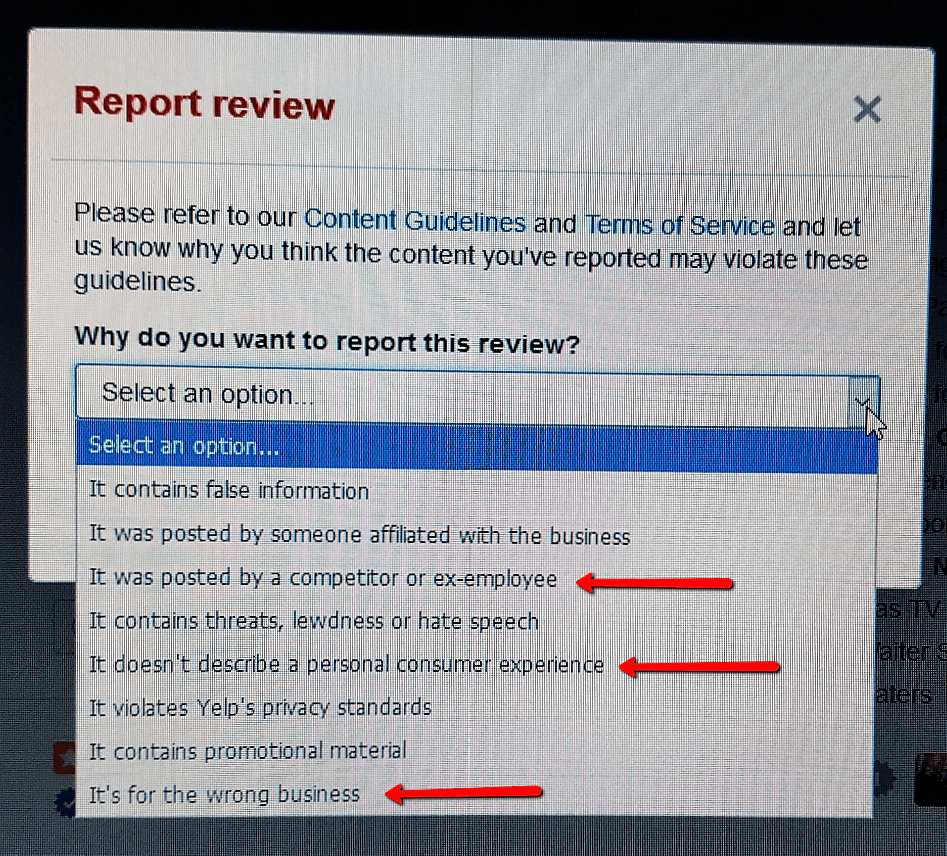
Flagging Yelp Reviews

You might think we would have used, “It was posted by a competitor or ex-employee”. However you have to be able to prove it was THAT person. Instead we flagged as, “It does not describe a personal consumer experience.” In the notes, use the following language:

“This rating does not reflect a consumer experience with our company. This individual is not known to anybody from our company. It has been posted by an individual who is trying to manipulate our ratings for the worse.”

Sometimes you might receive a review for your parent brokerage. Or maybe you represent the bank and the debtor goes “scorched earth” even though you never had contact with them. “Wrong Business” is self explanatory. If it is the disgruntled debtor, go with “consumer experience” and explain that you represented the bank. It usually takes 1 or 2 weeks for a response. All of the reviews we flagged for this client were removed. Upon success, you will get an e mail that reads(redacted):

Hello,

We’re writing to let you know that we’ve evaluated Mark J.’s review of YOUR BUSINESS that you recently reported. After assessing the review carefully against our Content Guidelines, we agree that this review should be removed. We rely on community engagement to help keep Yelp useful. Thanks so much for taking the time to bring this matter to our attention! For further information on using Yelp, please find answers to frequently asked questions in our Support Center (http://www.yelp-support.com). – The Yelp Support Team

Google

Our client had eight negative Google reviews posted since May. None of the reviews communicated an actual business experience. They were all personal attacks and name calling. They all came from Google+ accounts that had no prior activity. We went so far as to do searches on all the account names. One was a professional tennis player. One was a name that had no record in the USA. They all appeared bogus. Two of the reviews were left within minutes of each other and contained the same language. A sophomoric attempt at best.

The Google flagging process is a bit more complex.

In this order:

Leave a response like the one above: “This rating does not reflect a consumer experience with our company. This individual is not known to anybody from our company. It has been posted by an individual who is trying to manipulate our ratings for the worse.” You can add additional details. Be as factual as possible but not long winded

Start the flagging process by signing into your Google Business account. Click on the reviews tab on the left. Next to each review you will see three dots. Click on the three dots and you will see “Flag as inappropriate”. Then you will see this and hit continue.
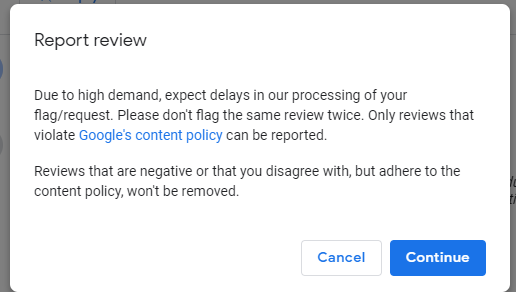
Google reviews

Next you will see this:

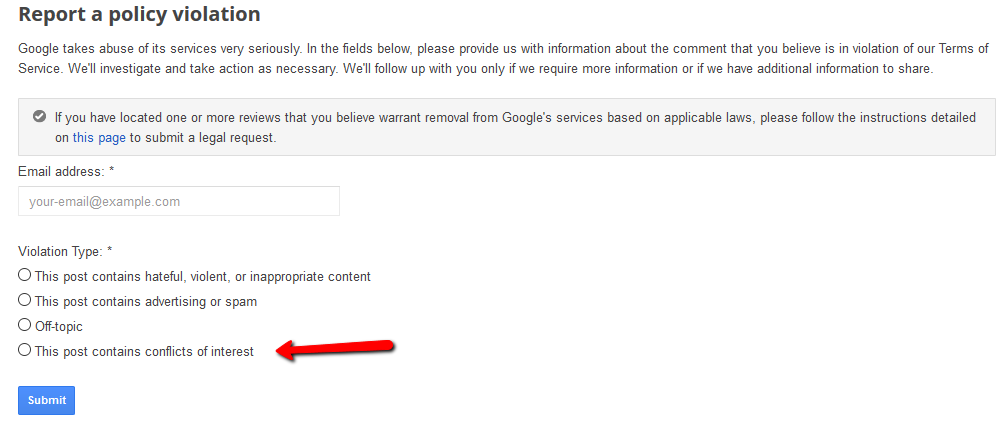
Dispute a google review

Click on “This post contains conflicts of interest” and be sure to put in your e mail address. I chose this option after hours of research into the Google policies and procedures of what constitutes a violation which might lead to a review investigation. You just completed phase 1

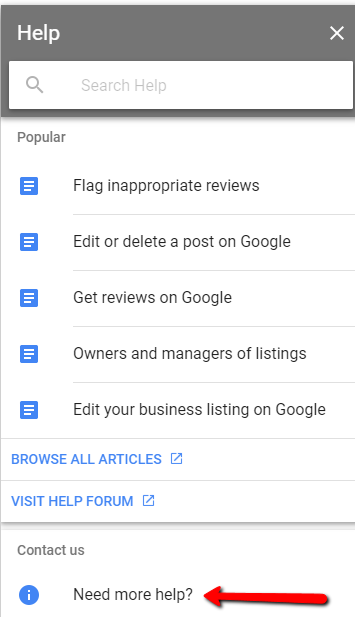
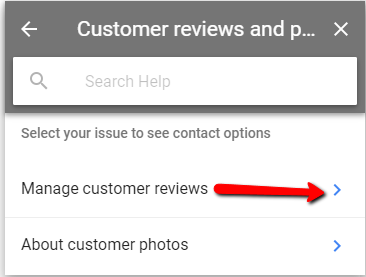
Wait 48 hours and sign back into your Google business account. On the bottom of the left sidebar you will see “Support”. Click there and you will see this. Click on “Customer Reviews and photos”
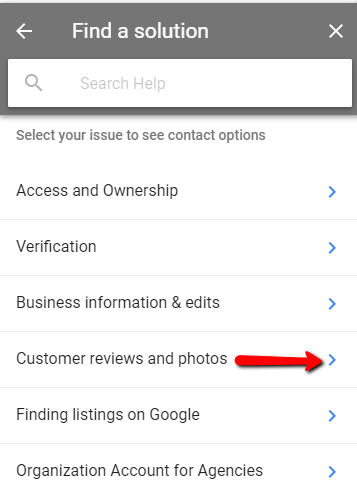
contest negative google reviewsNext click on “Manage customer reviews”.
Google reviews

Then “Need more help”

Google Help

Then e mail support. You will have 1000 characters to clearly communicate your case. With this client I communicated that it looked like they were all new accounts, and that the names did not line up. The content had been duplicated and this had probably come from the same IP address in that market.
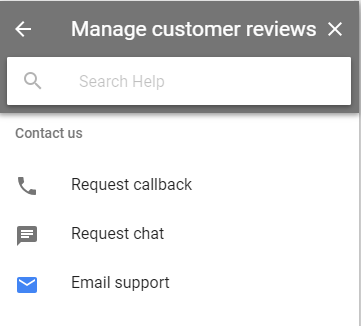
Contact GoogleGoogle states it could take up to three weeks for them to investigate the case. If you do not hear from Google or see the fake reviews removed from your Google Business page, then go through the same process to request a callback.

In this case, we had resolution within a week. 6 of the 8 reviews were removed and 2 are still pending their investigation.

This post is specifically about fake reviews from prior employees or associates. Clients or prospects you have never had contact with. They are not in your database. You don’t know who they are. If the negative review is from a prior contact, you need to deal with it. First, one on one to resolve their issue. Secondly, if un-resolvable, then leave a response to their review which you can do on most review platforms. Be honest. Be nice. Maybe go into some details. You need to show intent on resolving any issues and the humble pride you take with your online reputation.

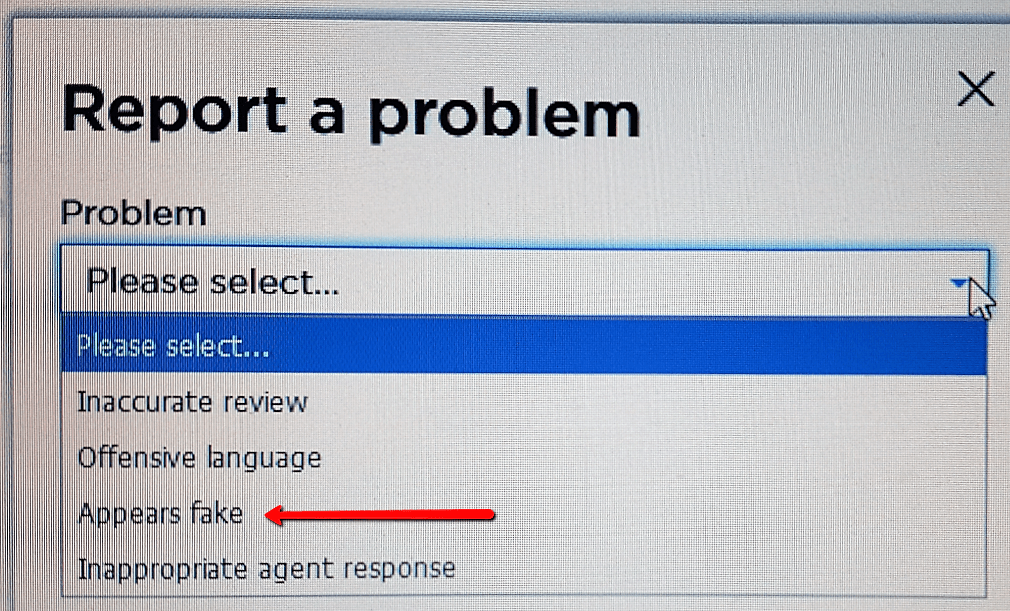
I noticed this alleged agent had four 5-star reviews on Zillow. Funny thing was, this agent was showing no completed transactions as far as I could tell. The only property he was representing was his parents house. I signed into my Zillow account last week and flagged each review as “Appears Fake”. I then wrote a short note on each flag suggesting Zillow audit the agent’s account. As of this morning, two of his reviews have been removed. Some might think I am taking this too far, however I am very protective of my agents and review fraud is fraud. An agent with fake reviews has no integrity in my book.
Not to go off subject too much, but we had another client 2 years ago that held the number one position in Yelp for their market. Suddenly out of nowhere, a competing brokerage was about to overtake them with the number of reviews. There were twice as many reviews as there were lifetime transactions. I started analyzing the reviews. They all came from one ethnic community of Yelpers throughout the United States. I also noticed the syntax of the content of the reviews was similar. In fact two of the same adjectives were used throughout many of the reviews. Most of the reviews did not communicate experiential consumer contact. They were just endorsements. There was enough circumstantial evidence that I used the same flag I spoke of earlier,  “It doesn’t describe a personal consumer experience”. Yelp reviewed their account and over 18 reviews were removed for violating Yelp’s terms and conditions. Again, fraud is fraud.

In closing:

1) DON’T PANIC if you receive a negative review from somebody you have never had contact with. There is a process in place to deal with it. The process is not always 100% successful, but it works of you communicate in such a way that your false review flag lines up with that review system’s policies on flagging. You need to write like a lawyer. I have a distinct advantage because I am a former fraud investigator and worked for law firms for a number of years in the late 90’s and early 2000’s.

2) Do not fear online review systems. Embrace them. Be proactive in collecting online reviews from your prior clients and your new clients when they are doing the happy dance at the end of the transaction.

3) We have a system in place that can manage this for you. AgentReputation.net

CJ Hays comments on discussions about Yelp and other review systems

I was on the Lab Coat Agents Facebook page today and came across a post regarding why a 5-Star Yelp review wound up under the line. I then read all of the responses up till now and many of them were accurate while others were errant and others were just hateful opinions. I decided to write up a post to share with the group.

1) Yelp wants ACTIVE Yelpers to be organically motivated to leave reviews. This is why you never send out a blast to the multitudes asking for Yelp reviews because their “Gate Keeper” algorithm will see a cluster of reviews coming in within a short period of time, which tells them you sent out a blast. They don’t like that. It’s not to say you can’t ask people for Yelp reviews one on one, but they have to be ACTIVE Yelpers.

2) Yelp knows when new consumer accounts are created. It knows 5 minutes later a Yelp review was left from a new account, never to be heard from again. This is also to protect you from haters, consumers you never did business with or ex-employees. In fact I wrote an article on how to get these types of reviews removed here.

3) You can’t game the system. Just getting friends and leaving 20 reviews, if done over a short period of time will not qualify that person as an active Yelper. Too much, too soon. And do you think asking your client to jump through a bunch of hoops just so that their review will be on top respects their time?  An active Yelper not only has a profile image and friends, but they need the Yelp app on their phone. They need a history of checking in from businesses like restaurants and leaving reviews over a period of time. Once Yelp sees a credible history, that review they placed under the line may be moved to the active section. I am an active Yelper.

Yelper

4) The Yelp conspiracy is a nothingburger. There were a number of over zealous sales people back in the day that would lead you to believe if you did not buy their advertising, your good reviews would be pushed down. That was never company policy. Some still try the pitch from time to time but you need to call their bluff and report them. The FTC investigated and took no action. And there are ways to get bad Yelp reviews removed as noted in an article I pointed out above.

5) You can hate Yelp but you really need to embrace Yelp. Sure you can choose not to establish a Yelp page for your business and focus on other review systems, but it can also be a major source for leads. I know many agents that get leads regularly from Yelp. And if you acquire a good amount of Yelp reviews, that is the time to advertise. And, Yelp uses the gold star system which helps in making your online reviews look more rounded.

6) Claim your Yelp or Google account. If you have not established a Yelp business page or Google business page, sometimes they create them on their own from business license databases. I am not a fan of this at all because people can still leave reviews on unclaimed business pages. You can always get them removed but it is better to claim them, add accurate information and be proactive to get 5 star reviews.

7) Google is great. It is safe to assume if the largest search engine in the world has a review system, you should probably pay attention to it. Make sure people write out a full review and not just leave a star rating. The more experiential content the better. Same goes with Yelp. They rate the reviews on experiential content and the amount of words used. If you do not have a Google business page, go here to create one. This places you in the Google business directory and you could wind up in the “three pack” on page one of Google for Realtor search results.

8) Google has a gate keeper as well. If the individual signs up for Google+ just to leave you a review and is never heard from again, the review might get ghosted or moved down the list. Organics is important.

9) Facebook has a gold star system that will show up in the search results. Just about everybody has a Facebook account and it is usually active on their phone or computer. Facebook is always the fallback if your clients are not Yelpers or Google members. In addition, it’s harder to leave fake reviews on Facebook.

10) If you are a Zillow Premier Agent and/or buying leads and you don’t have a competitive amount of Zillow reviews for your market, you are not the shiny penny.

11) Be proactive. I know of agents that prep the buyer/seller for future reviews in the beginning of their relationships. As in, (paraphrasing), “when we get this done I am going to ask you to leave me some online reviews” and then asking again while the client is doing the happy dance at the conclusion of the transaction.

That’s pretty much it. I figured it would be easier to write in a post vs just going on for days in a Facebook reply. Thanks for your time.

CJ Hays


Yelp DOES protect businesses from non-consumer experience review attacks

Do you remember last year when that dentist from Minnesota killed the lion in Africa? I was curious as to if the public would go to the Yelp page for his business and trash him. They did just that. I followed his reviews for a week and the one-star reviews just piled up. Other then manually flagging these reviews because the review “… doesn’t describe a personal consumer experience”, I was curious if Yelp was going to step in and filter the “attack” reviews. For the past year if a business owner made the news for being horrible, the same thing usually happened.

Locally, the El Sombrero Mexican Bistro in Las Vegas was under fire because Donald Trump paid them a visit. I only ran across this due to a story in the Las Vegas Review Journal yesterday written by Colton Lochhead, featuring the headline, “Las Vegas restaurant still cookin’ despite Hispanic community stir from Trump visit“.

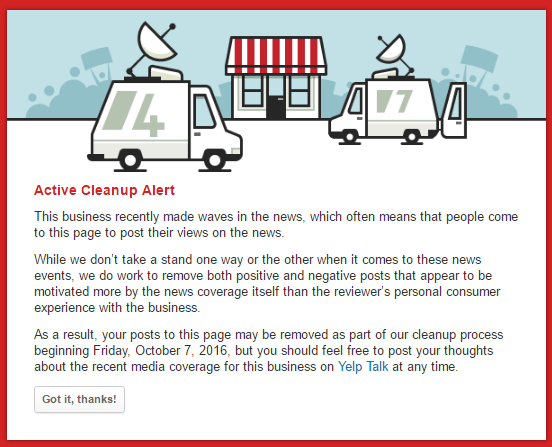
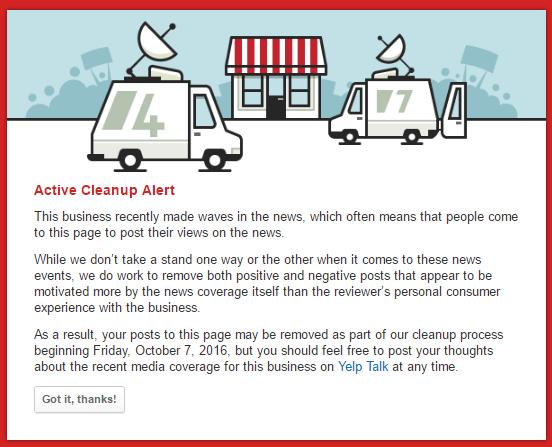
So once again, in conducting research for our reputation marketing business, I went to the Yelp Page for the El Sombrero Mexican Bistro to see if the political attack reviews were hot and heavy. I was surprised to the the following pop up window:

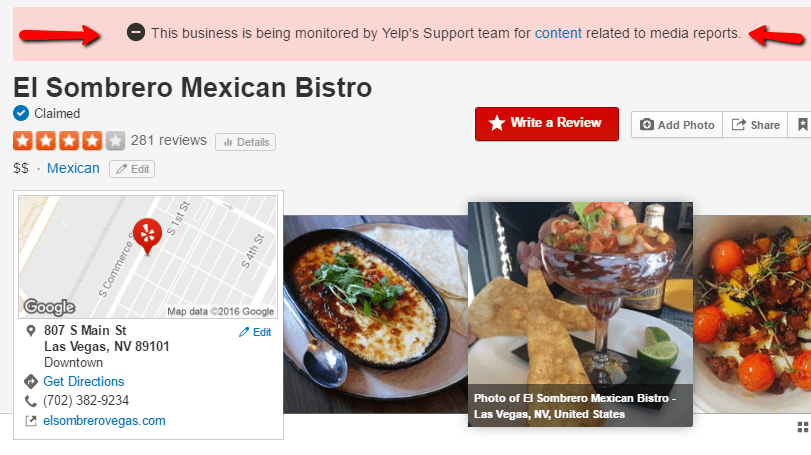
I had never seen a notification like this from Yelp ever. I was pleasantly surprised to see Yelp proactively protecting the online integrity of a small business from non-consumer reviews. Once you click “Got it, thanks!” and you are taken to the page this statement is in the header:

Living in Las Vegas and as a “Foodie”, I love going out to family owned, small, off the strip restaurants. I am also an active Yelper. Locally and when I travel, I rely on Yelp for trying new places. When the general public starts attacking a business due to politics it skews the online review process of whether the El Sombrero Mexican Bistro is a great place to eat.

FOOD not Politics

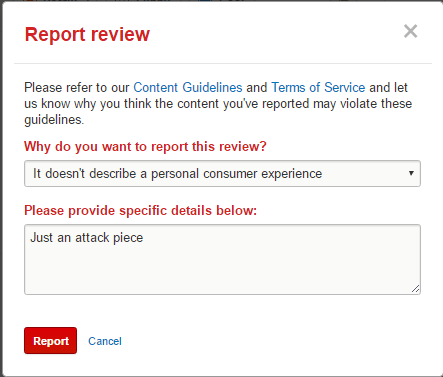
With that said, if you are a Yelper and ever see a post that does not represent an actual consumer experience, you can flag the review like I did here:

If you are a small business owner, whether a presidential candidate visits you or not, you should always be aware of your online reputation.

Realtor reviews from Yelp and Facebook now showing up in Google Business pages

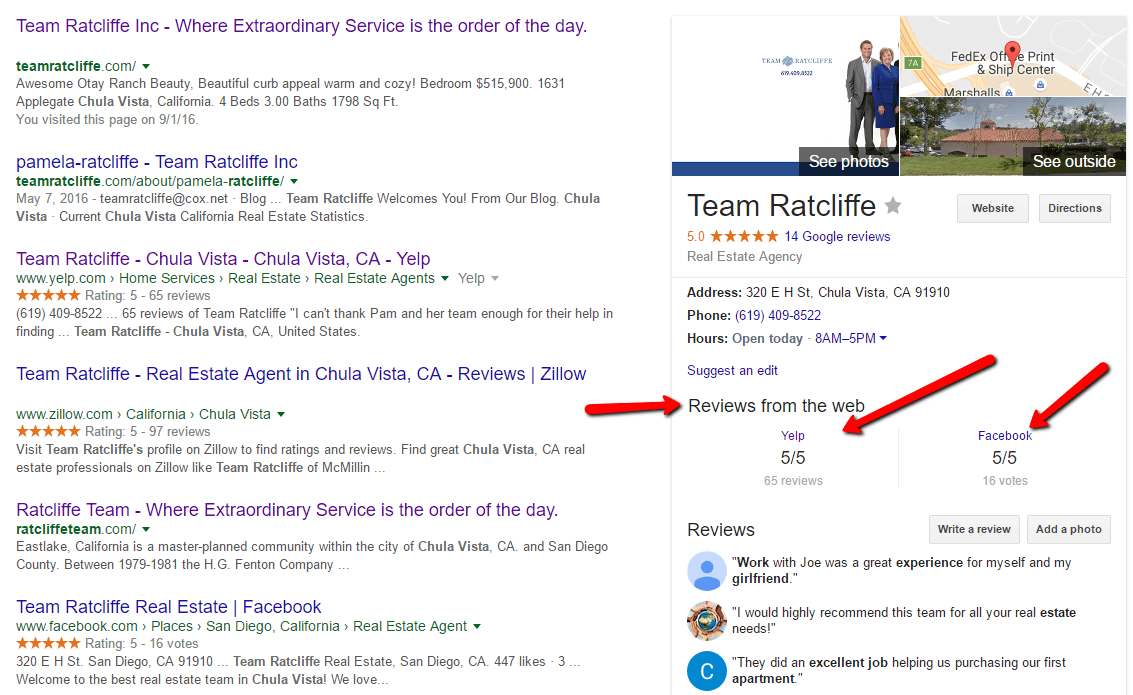
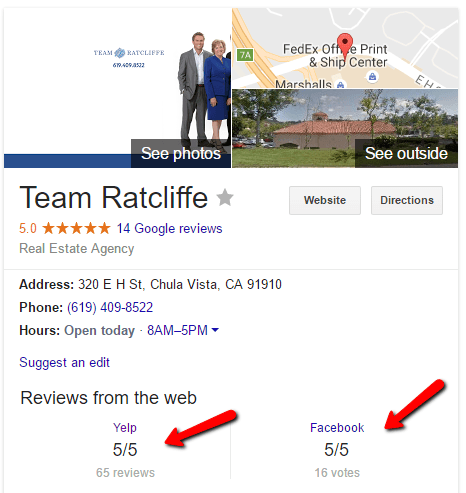
We ran across an exciting addition to the Google Business Page boxes that appear in the upper right of Google page one search results for for businesses that have created or claimed their Google business page. You have heard me say, “If the largest search engine in the world has a review system, you should probably pay attention to it”.  This is why we promote the use of Google reviews as a primary source of your online reviews. Based on the image below, you will see in addition to the Google reviews, you will see Facebook and Yelp reviews are showing up in the Google business box section called “Reviews from the web”.

From a perspective of the importance of having online reviews, the fact Google has added Yelp and Facebook reviews to their business box is quite telling. From what we can tell, the reviews are being automatically pulled and placed in the Google business box and is not a direct feed based upon some official data pipeline between Yelp, Facebook, Google and others. Here is a short video I did explaining it.

In a prior blog post where I wrote about stats that came directly from Google regarding the fact 49% of your prospects want to trust you along with this latest addition of Yelp and Facebook reviews shows me now it’s more important then ever to take control of your online reviews. Please reach out to us for a free demo on how we can manage all of this for you.


Realtors need to quit trying to manipulate Yelp

Referencing a blog post I wrote on Active Rain earlier this year, I continually see Realtors trying to manipulate their Yelp reviews. Enough real estate agents know about me and my company, Agent Reputation, that I am continually getting questions about how to get Yelp reviews to stick. Or maybe they think there is some kind of conspiracy that requires buying advertising from Yelp in order to get non-recommended reviews published or bad reviews removed.

  1. No conspiracy. There were some overzealous Yelp sales reps back in the day that may have inferred a relationship between reviews and ads but that was firmly dealt with. Anybody that claims different is misinformed.
  2. Yelp does not want you asking for reviews. They want “active” Yelpers to be motivated by the service you provide to leave organic reviews. As a real estate agent, you can have a Yelp presence on your website or reputation marketing program and the Yelpers who feel motivated will know what to do.
  3. DO NOT send out an e mail blast asking everyone you know to leave you a Yelp review. Yelp has an algorithm that tracks the review. If you send out a blast, Yelp will see red flags because too many reviews came in at once which is an indicator you sent out a blast asking for reviews. Secondly they track new Yelp users. They know when somebody signs up just to leave a review and depending on their future Yelp activity, this review will wind up under the line as a non-recommended review. This can also protect you because it will also push some of your bad reviews under the line. So basically if you went to the effort to ask a bunch of non-Yelpers to leave you a review, you just wasted their time when they could have been leaving you a review on Google, Facebook or Zillow.
  4. What is a Yelper? A Yelper signs up to participate in the online review community. They are interested in the reviews of other Yelpers and are motivated to leave their own reviews. Yelpers have a profile photo. They have downloaded the Yelp App to their phone. They check in from businesses they are visiting via the app. They write reviews from these businesses they have checked in from. They have Yelp friends and at the end of the day if these active Yelpers leave you a review, it will be above the line and credible.

Yelp should be embraced. I have real estate agent clients that have over 50 positive reviews with very few under the line. And in fact once these clients get their reviews up they are buying Yelp ads and are killing it.

CJ Hays – Follow me on Twitter

#CJ4marketing

CJ Hays Featured on Super Agents Live Podcast with Toby Salgado

I was asked to be a guest on Super Agents Live hosted by Toby Salgado a few weeks ago. I discussed online marketing strategies for real estate agents including online reviews, reputation marketing and the correct use of Youtube. This marketing podcast is an hour in length and can be accessed here. I start around 4 minutes into the broadcast.

CJ Hays – Follow me on Twitter

#CJ4marketing

Why some Realtors think Yelp is harming them – Stats and Algorithms

First off I want to give a shoutout to Matthew Bushery at Placester.com who recently wrote a great article on Yelp.

Today’s post is inspired by a Realtor I spoke to this afternoon as I was going over their reputation report. Other then their awesome Zillow reviews, the Google footprint was a bit weak. And their Yelp page showed 7 reviews with a 2-Star average rating. There were “18 other reviews that are not currently recommended” below the line.

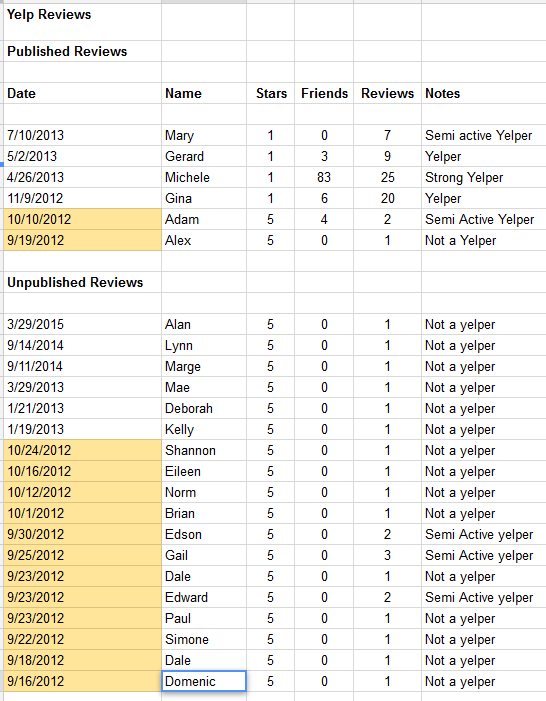
This always upsets companies or business professionals reviewed on Yelp. Using this image below, I will lay out a response that will hopefully help you to understand a bit more about how Yelp works.

When I Googled this Realtor, the 2-star Yelp review was staring me in the face. I know they felt harmed by Yelp for hiding 18 5-star reviews and publishing four 1 star horrible reviews. Setting aside the fact they will never be able to terminate their Yelp account, I wanted to offer some insight.

Two of the negative reviews stated the reviewer actually had completed real estate transactions with this agent. I had suggested that if these two reviewers were making this up, the agent could ask their broker to write a letter stating they never had clients with these names which could be submitted to Yelp for review.

On or about 9/16/2012, this agent or somebody representing them sent out an e mail to a mix of prior clients, friends or family letting them know they established a Yelp account and they were asked to leave you a 5 star review.

Starting on the 16th and continuing through 10/24/2012 a total of fourteen 5-star reviews came in to Yelp. That is unnatural and is a big red flag. Then when you see that most of these reviews have had zero activity in the past three years, based upon their algorithm and tracking, Yelp assumes they asked all of these people to leave them positive reviews which is against their guidelines.

The “zero friend/one review” accounts under the line, most likely signed up to leave them a review and then immediately left that review, never to be heard from again on Yelp. Yelp tracks that. You simply cannot ask non-Yelpers to leave you reviews or they will be buried.

Now IF any of the inactive Yelpers became active, there is a chance this activity might get the reviews after 10/24/2013 published

I was going to suggest getting an additional letter from the brokerage or providing transaction documentation tied to each name of those below the line for submittal to Yelp, but if it was within the dates I mentioned, it probably wouldn’t matter because so many reviews came in within such a short time-frame. You might be able to do this with the three reviews from 2014/15 and get those upgraded.

They have all of these reviews from 2012, most of which don’t count. Six from 2013. Two from 2014 and only one this year. This shows they had a push in 2012 and then sat back to allow natural review postings which is why these four one star reviews are published along with the reviewers Yelp activity.

A correct strategy at the moment the client is doing the happy dance, for all transactions moving forward, is to mention you are building your online reputation and to find out if they are active online reviewers. It really would not take many to push you up. But they have to be Active Yelpers.

They want active Yelpers to be motivated to find the vendors they do business with and leave honest reviews on their own. You also can’t just sit back “hoping” you get reviews. You have to be proactive. You need a plan. We have that plan.

CJ Hays @area51testpilot #CJ4marketing

Thoughts on Inman News Article re Online Agent Ratings

On August 6th, Inman News published an article called, “Online agent ratings may be inflated, but they’re still valuable”, written by Teke Wiggin, Technology Writer for Inman. The article seems to be focused on Zillow reviews. I will go point by point.

“Realtors have become restaurants” is the name of my seminar, so when I saw the opening paragraph of the article stating that consumers were using third party review systems for restaurants, hotels, and product purchases, I was pleased to anticipate the body of the article.

YES, consumers are using third party review systems like Yelp, Trip Advisor and the like to look at the credibility of vendors or products. However, while a foodie may use the Yelp app via their phone to look for a quality restaurant, the majority of consumers are first using the search engines to look for (Google) the name of the business, business professional or product. Consumers are Googling Realtors.

What do they see on page one of the search? Do they see gold stars? Do they see only Zillow? Do they see a Realtor’s Yelp account? Does the Realtor have a Google business page? Do they have Google ratings? Seriously, when a consumer Googles a real estate agent, they had better see multiple review systems in place. Having reviews across multiple platforms increases the credibility of the business professional.

A statement is made in the article that online agent ratings may be inflated. What does this mean? The article seems to tie this statement to the fact that Realtors are only asking the really happy consumers to leave reviews, thus skewing the online rating of the agent. Yes, if you as an agent are guiding ONLY your happy consumers to leave you positive reviews on Zillow or elsewhere, then a consumer may not be seeing an accurate representation of your integrity and professionalism. With that said, most consumers won’t realize this.

Another statement reads, “The reason why negative reviews are few and far between may be because many people who aren’t thrilled with an agent’s performance don’t feel the need to broadcast their disappointment”. I totally disagree. You have heard variations of actions consumers will take depending on their satisfaction with a product or service. They might tell a few people if they’re happy, but they will tell the whole world online if they are really upset!

The question is whether or not the agent is tech savvy enough to have third-party review technologies in place, other than Zillow or an internal survey based system. Yelp can be a little intimidating for agents that don’t know how to use it correctly. You can embrace Yelp to your advantage. I have clients getting 10 solid leads a week from Yelp, but that is for another day.

Google Business is also a huge factor. It is safe to assume that if the largest search engine in the world has a review system, you should probably pay attention to it.

When I had first read the headline that “agent ratings may be inflated”, I thought the article had to do with the fact Zillow reviews can be gamed. And in fact, there are methods to game almost every review system with the exception of Yelp. As a former Fraud Examiner and having worked many online fraud cases, a number of odd agent reviews were brought to my attention which I investigated. I saw review numbers that did not add up.

I know, for instance, when we load a client’s customer list into our CRM, which sends out an email asking them to click on a link to leave an online review, we will get a 25% return. That 25% does not come easy. There is an entire trickle system in place to get the customers to leave their online reviews. I then compare the percentages I am aware of to numbers that seem excessive. When I see rating numbers that are equal to or even exceeding the known transactions of an agent, the red lights go off. I know how it is done.

If you are a Zillow client and you focus on Zillow for your lead generation, then by all means focus on your Zillow reviews, as you will stand out within their marketing system. Same goes for Trulia and Realtor.com. But please open or claim your Google and Yelp pages. I may not click on your website or Zillow, Trulia or Realtor.com page to see your reviews.

Internal vs External Online Reviews for Realtors

“Realtors have become restaurants”. This means consumers are Googling realtors like they would a restaurant, looking for their online ratings and reputation. People want to go to major directories that they trust and rely on everyday for reviews about products or services before they buy. What your prospect sees in the first 5 to 10 seconds in the search engines is EVERYTHING.

Things have changed for realtors online. Back in the day (not long ago), realtors, teams and brokerages dominated the organic search results. Most of the consumer property searches were taking place on realtor or team websites. Now they are using Zillow, Realtor.com, Redfin and Trulia for their searches. Even longer ago, the consumer was spending more time on your website reading your content. Today they are looking for houses. They want to see that you have testimonials, but the majority are not actually reading them in detail. In fact, when I was in the real estate website business, we would always have a testimonial page that had a two sentence snippet with a button that said “read more”. Nobody ever clicked on the read more link because they just want to know you have testimonials.

We know realtor reviews are important. We knew this over a year ago when Sean McCrory launched Agent Reputation. Many clients later, the subject is coming up more and more at real estate technology events and national franchise meetings. Reviews were discussed at the T3 Summit and T3 experts released a report on realtor reviews. Placester published an infographic from survey results. I agree with most of the results, and I get the fact that when you are paying Zillow for marketing, it is wise to have as many Zillow reviews as you can get.

I have also heard, “Regain control from 3rd-party review sites”. It has been suggested to use an internal survey system to create internal ratings and reviews that people can see when they go to a realtor’s website. I love surveys to help the agents learn how to better serve their clients. We have surveys, but that is not the focus of this post. Some of the “teachers” out there are promoting INTERNAL reviews because everyone is scared of BAD reviews. They are scared that somebody might go sideways on Google or Yelp. That is OK, providing you have enough GOOD reviews. Having no reviews can be just as bad as negative reviews. People want to see reviews on a major directory that they trust, before making a buying decision. Surveys have shown that if you do not have at least 6-10 positive reviews, many potential clients will not trust your service.

A very high percentage of your prospects, especially listing prospects, are Googling you. What they see in the first 5 to 10 seconds, on page 1 of the search results, is everything. There should be 5 gold stars everywhere and not just the review systems provided by the likes of Zillow and other real estate vendors. It is pretty safe to assume if the largest search engine in the world has a review system, you should be paying attention to it. All realtors should have verified Google business pages so that you have an opportunity to get on the Google 7 Pack (that just came back for residential realtors).

Most agents know they need to focus on agent online reviews. However, as an agent, you need a method to facilitate getting the third-party reviews. We do that.

Let’s get back to the subject matter. If I just want to Google you, how am I seeing your internal reviews? Do I have to assume they are on your website and then go to your website and then click on a link to see them? What if you don’t have a website or are using the free site your franchise or broker is providing you? What the search engines see is more important than your INTERNAL system.

If you have one, how really satisfied are you with your reputation vendor? Are they facilitating your reviews out to the third party sites like Google Reviews and Yelp? Are you in the Google 7 Pack? Call us for a free testimonial commercial.